Skoltech-born Ligand Pro startup has made drug candidates screening more than 30 times faster
April 1, 2026


Ligand Pro, founded by Skoltech professors and a Skoltech PhD student, has presented Matcha, an AI-powered molecular docking model that performs virtual drug screening 30 times faster than the large co-folding models of the AlphaFold class developed by Nobel laureates, while surpassing them in both accuracy and physical correctness of the results. Matcha opens up new possibilities for virtual screening and early-stage drug development.

The Matcha algorithm is described in the preprint. To enable independent verification of the results and the integration of Matcha into existing R&D processes, the researchers made the manuscript, code, and model weights openly available.


How do drugs work at a molecular level?

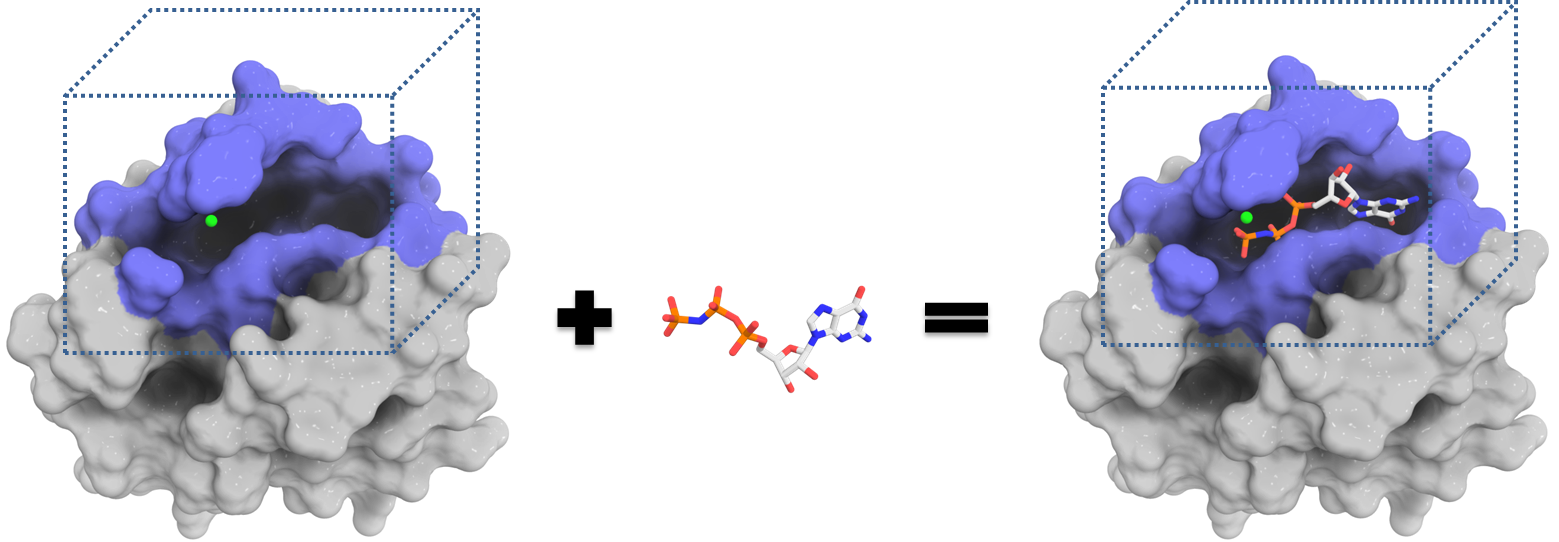
Disease often occurs when one or more proteins in the body stop functioning properly. A “broken” or malfunctioning protein is called a therapeutic target.The drug aims to alter the activity of its target by interacting with it. Due to their properties, drug molecules selectively bind to a cavity in the protein called a binding pocket. The binding pocket is like a keyhole. If the drug molecule has the right shape and chemical properties, it will slip into the pocket like a key and alter the protein’s activity.

subscription
Source: DockThor.
What is molecular docking and how is it used?

Researchers use molecular docking, a computational technique that matches molecules to proteins without laboratory experiments, to find or design the “key.” This method evaluates how well a molecule might fit into a protein’s pocket based on its shape and chemical properties.

Docking has become an integral part of virtual screening, which is a fast, computer-aided method of sorting through millions of compounds to find promising drug candidates. Virtual testing of potential candidates before bringing them to the lab can save years of work and millions of dollars.

A lack of precise 3D protein structures is a common obstacle to docking. In 2020, DeepMind introduced AlphaFold, an AI system capable of predicting 3D protein structures with high accuracy. This breakthrough earned its developers the 2024 Nobel Prize in Chemistry, ushering in a new era in computational biology.


Speed is of the essence

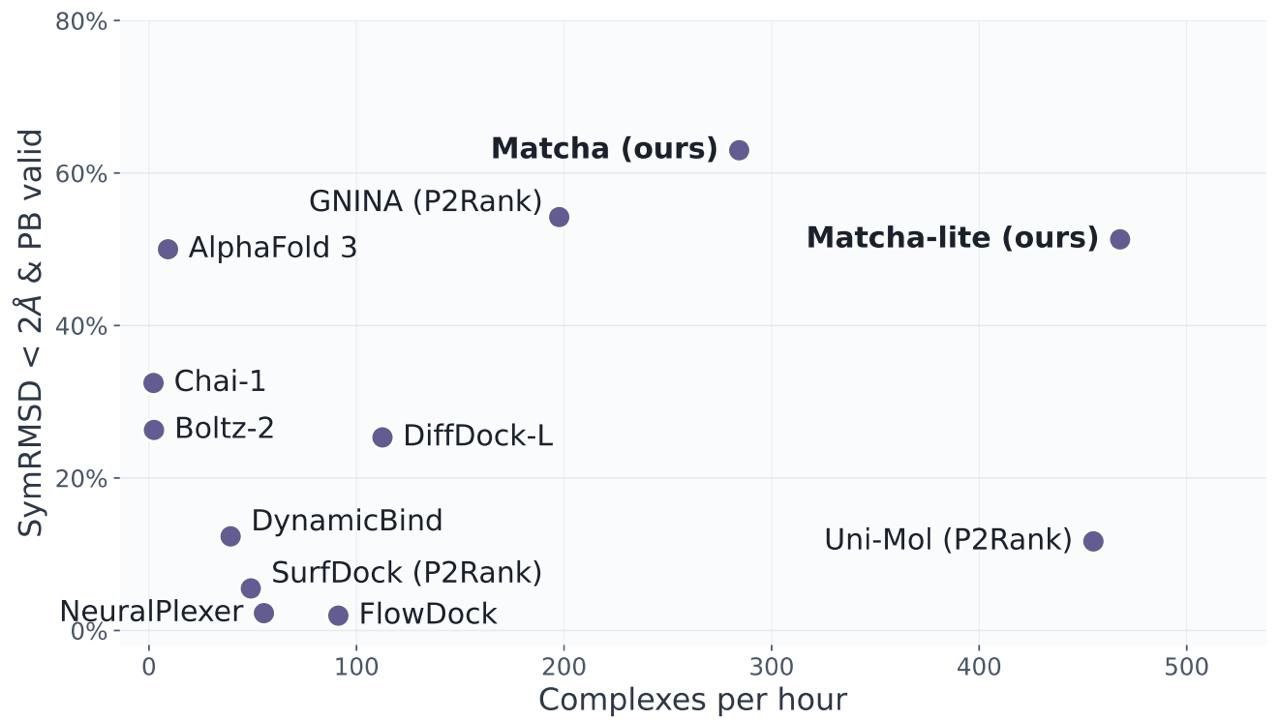
Even with readily available 3D protein structures, quickly matching millions of molecules to proteins remains a significant computational challenge. Matcha outperforms AlphaFold3 by a large margin, processing a single protein-ligand complex in 13 seconds compared to AlphaFold3’s 6.5 minutes. It takes AlphaFold3 four and a half months of continuous computation to work through a database of millions of compounds, whereas Matcha can complete this task in less than eight days. This means Matcha is 30 times faster, while offering comparable accuracy; furthermore, Matcha offers more physically reliable results. This makes cumbersome virtual screening feasible even for mid-sized research centers.

subscription

Source: Paper preprint.


Matcha accurately verifies the molecule’s location within the protein step by step. First, it determines the molecule’s approximate position, and then adjusts its rotation and internal torsions. The predicted configurations are minimized with a physics-aware GNINA method, while the embedded verification automatically discards physically unrealistic configurations. The remaining positions are ranked by the predicted GNINA affinity to select the optimal one. Matcha has demonstrated highly accurate and physically reliable predictions when processing standard datasets, all while maintaining record-breaking speed. 

“Drug development is a long, capital-intensive, and high-risk process. A project can be stopped at any stage, even after significant time and effort has been invested. Even so, computational methods can optimize the early stages particularly well. Our mission is to create effective AI-based tools that would establish a comprehensive computational framework in the early stages of drug development. Improving the efficiency of this stage increases the likelihood of success and accelerates the launch of new drugs to market,” said Marina Pak, a co-founder and CEO of Ligand Pro and a Skoltech alumna.

“In just three years, we’ve gone from proposing an idea and building a team to achieving game-changing results. We continue to develop Matcha and address related tasks, including the generation of molecules, prediction and optimization of their properties. Our next step is to validate our solution experimentally in real R&D pipelines, and then proceed with industrial implementation,” said Daria Frolova, the head of machine learning at Ligand Pro and a Skoltech Computational and Data Science and Engineering PhD student.