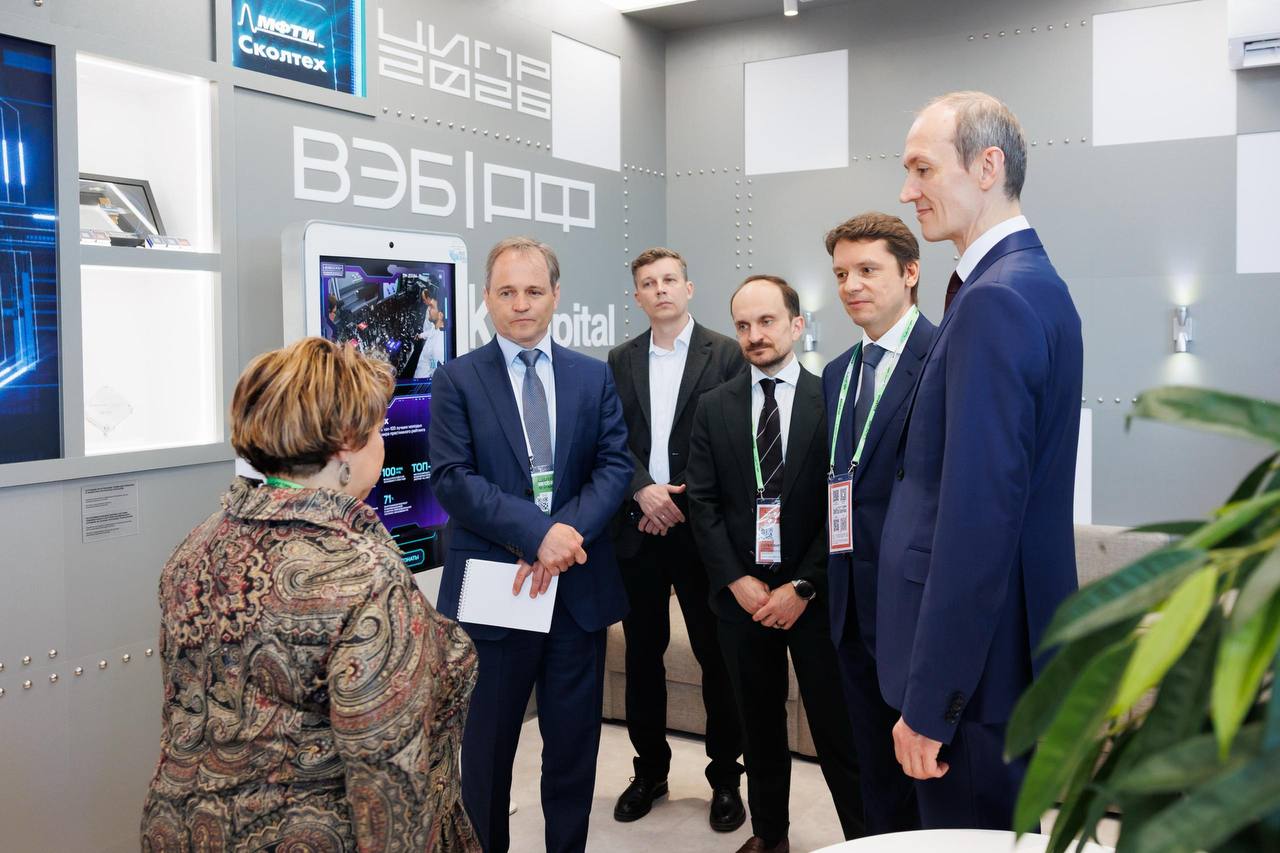
At VEB.RF’s “Digital Fortress” booth exhibit, Skoltech President Yulia Gorbunova presented the institute’s solutions to Deputy Prime Minister Dmitry Grigorenko:
Laser communication will increase inter-satellite data transfer rates to nearly 100 Gbit/s. The coherent transmitter based on photonic integrated circuits (PIC) uses advanced signal modulation formats that multiply the information density per channel. The prototype has passed flight qualification.
The first locally manufactured coherent transceivers in backbone networks and data centers will be based on a fully functional prototype of a transceiver on a photonic integrated circuit.
The solution is based on fiber-optic sensors and a compact interrogator using photonic integrated circuits and machine learning algorithms. A flight prototype for 3U CubeSats is expected to be ready by the end of the year.
These circuits meet mass microelectronics production standards, proving the potential of the Russian photonic integrated platform for the digital industry. The samples have passed testing and are ready to be integrated into real electro-optical systems.
The sensor uses a Paul ion trap and PIC elements to enable high-precision gravitational mapping of the Earth. This opens up the possibility of autonomous navigation in the absence of a GPS signal.
As part of the business program, Skoltech organized two sessions at the VEB.RF venue. During the “From Models to Machines” session, leading developers and technology customers discussed the barriers to implementing laboratory models in real-world businesses. Skoltech Vice President for Technology Partnerships Shamkhal Dzhabrailov moderated the session. Below are some brief insights from the participants:
Alexey Zaytsev, an associate professor at the Skoltech AI Center, believes that if only ten percent of companies succeed in production, it is not a failure:
“Companies had a year to bring this super-heavy technology, which will transform business processes, to production. Ten percent of companies completed the task, while the rest are still working on it. I’m very optimistic about the situation.”
Zaytsev emphasized that the impact of AI implementation cannot always be expressed by a single, direct figure. Along with the model, a company often acquires new competencies, computing infrastructure, data ontology, and data collection and storage logic. These changes transform the data culture and enable the faster launch of future AI projects.
“Technological leadership in AI is defined by the ability to transform models into products, evaluate their effectiveness, and develop infrastructure, rather than by the quantity of models alone. Businesses need solutions to their business problems. Nothing will happen until we transition from scientific research to productization.”
Trust in models, continuous monitoring, and model stability are equally important components for the AI industry.
Large LLM models make it impossible to run the entire test suite because everything depends on prompt scenarios. New open-source models are released every two weeks, so companies aren’t tied to a single model. The internal platform includes a set of model repositories that can quickly adapt to specific solutions.
Following up on the topic of productivization, Nikolai Trzhaskal, the director of AI technology development at FabricaONE.AI (Softline Group), noted that productivization implies a step down to the level of platformization:
“Advancements in AI are lowering the barrier to entry in software development, creating a need for a platform where each company can develop its own architecture.”
It is also essential to change the culture. Instead of blindly trying to prevent AI-related risks, we should learn to properly assess and calculate them.
“Research shows that only 5-7% of organizations that use generative AI in their processes have reaped economic benefits from its implementation. Key challenges include a lack of in-depth internal expertise and proficiency among users in working with AI, as well as the high cost of computing resources.”
He also shared an interesting case in which VTB, together with T1 and Chinese partners, successfully adapted alternative Nvidia solutions. They created the country’s largest Nvidia-free cluster, which is independent of the American monopoly. This helped create fully import-substituting solutions.
Igor Drozdov, the deputy chairman of VEB.RF, began his speech by stating that Skoltech is part of the VEB.RF Group which relies on the institute to support the AI industry. Nevertheless, demonstrating a project’s economic efficiency and ensuring a return on investment remains a bank’s primary criterion.
“To keep up with global progress, we are developing and implementing various solutions. However, we are still in the process of testing hypotheses. AI is a support tool, and humans should make the ultimate decisions.”
At VEB.RF, Nataliya Kosmodemyanskaya, the head of Skoltech’s Project Support Department, moderated another Skoltech session, “Developing 5GA/6G: Promising Technologies through Cooperation between Science, Government, and Business.” In her opening remarks, Kosmodemyanskaya emphasized that although the commercial implementation of next-generation technologies is not expected until 2030, the entire world has already joined the race.
“Our initial conditions are more complex. 5G networks haven’t been widely deployed yet, and the country is facing many other pressing challenges. However, Russia has recently begun developing its own 6G research and technology agenda.”
Deputy Minister of Digital Development Alexander Shoitov noted that a fast internet connection is essential for implementing the data economy, and that the country needs new, efficient systems. In 2025, the ministry launched a roadmap for developing key 5G Advanced and 6G technologies. Skoltech won the competition, Shoitov recalled. He emphasized that all critical 5G Advanced technologies should be fully developed by 2030. He concluded that most of the groundwork for 6G should be laid by then.
“In 2023, we built the first experimental 5G base station. This work continues as part of the roadmap, and we thank the ministry for its support. We have identified three critical areas of the roadmap: software incorporating AI elements, digital twins, and PIC-based antenna systems. It is also important to collaborate with the government, vendors, and operators to identify and clarify objectives and receive feedback.”
“To be honest, our universities only have a few scattered cooperation projects. Low technology readiness is yet another issue. I hope the roadmap will help establish systemic cooperation with industry.”
“In order to move forward and plan for the implementation of 5G Advanced and 6G technology, we must adhere to the core principles of economic feasibility and return on investment. AI is not just a passing trend, but a clear necessity during this transition phase, because a large number of tasks cannot be managed using conventional superstructure systems.”
“We try to make sure our product is marketable both locally and globally. We want to understand the industry and follow its lead. One of our team members is always working on promising technologies.”
“During the development process, we have encountered both a lack of input data and discrepancies in the specifications. We must eliminate inaccurate information from manufacturers’ marketing documentation. To do so, we must establish independent pilot zones in Russia.”
“We’ve tested about 80 startups at our Demo Center. We also plan to open two or three more 5G pilot testing centers in Moscow.”
According to Novikov, the Moscow Information Technology Department works closely with universities on advanced research projects. Its study of global 6G trends could be the basis for developing Russian cooperation models.