Skoltech’s new method makes neural networks three times faster in wave propagation problems
April 7, 2026

Researchers at Skoltech have proposed a new approach to training neural networks for wave propagation in absorbing media. The method significantly improves the accuracy and stability of solutions and accelerates model training in the design of laser fusion systems, high-power laser facilities, and optical schemes with plasma elements, where the calculation of wave propagation and laser-plasma interaction consumes a significant portion of computational resources. The results are published in the Communications in Nonlinear Science and Numerical Simulation journal.

Physics-informed neural networks are widely used to solve differential equations, but in wave scattering problems, particularly those governed by the Helmholtz equation, they face substantial limitations. Strong oscillations and a wide range of amplitudes make the problem stiff, which slows training and reduces model stability.

In this work, the authors reformulate the original equation as a pair of decoupled first-order equations and then learn the ratio of forward and backward wave amplitudes. Instead of approximating the wave field directly, the neural network learns a quantity related to the reflection coefficient, while the phase is recovered by quadrature. Transparent boundaries are enforced through a hard constraint.

The proposed method, called Lie-generator PINN, preserves the physical structure of the problem and therefore leads to more stable training. In addition, the first-order formulation removes the need for second derivatives and reduces computational complexity. The authors stress that the point of the work is not to outperform classical solvers, but to make PINN-based methods themselves more physically grounded and reliable.

subscription
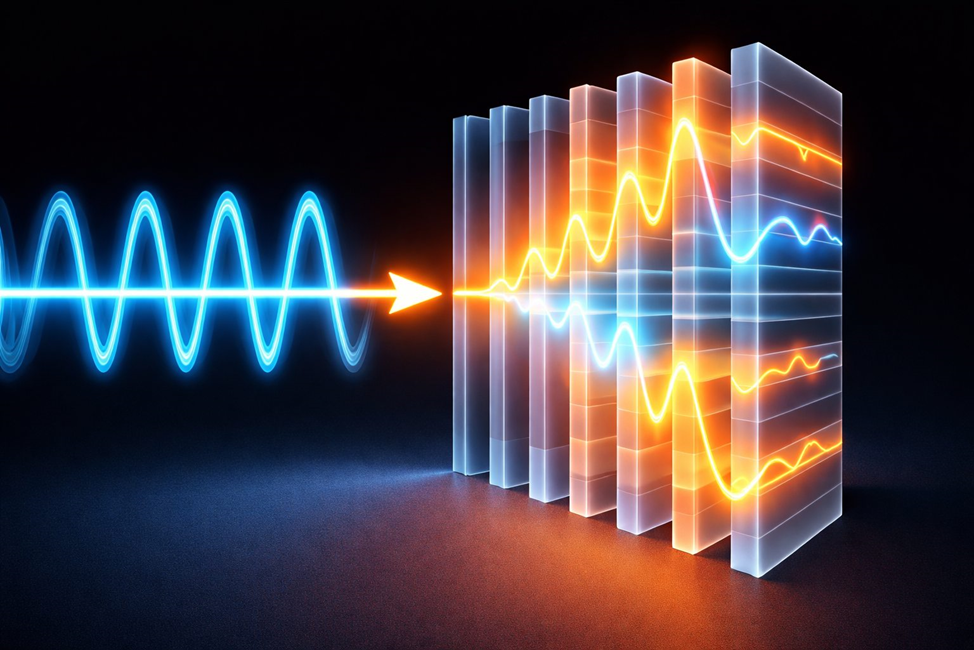
Generated schematic illustration of wave propagation in an absorbing medium, a class of problems for which Skoltech researchers proposed a new approach to neural network training.

“The method was tested on several representative profiles of complex permittivity, including absorbing and reflectionless media. In numerical experiments, the new model reduced the mean absolute error by up to an order of magnitude and trained about three times faster than a vanilla Helmholtz PINN,” commented a study co-author, Associate Professor Sergey Rykovanov, who heads the Skoltech AI Center’s Artificial Intelligence and Supercomputing Laboratory. 

“We have shown that taking the intrinsic structure of the equation into account can significantly simplify the task for a neural network while improving accuracy, especially in high-frequency regimes,” said the lead author of the study, PhD student Bari Khairullin from the Computational and Data Science and Engineering program.

The approach opens new opportunities for applying neural-network-based methods in computational physics, including laser-plasma problems, photonics, and quantum mechanics, where fast and stable modeling of wave processes in complex media is required.