Multiscale residual stress evaluation can improve the reliability of aircraft engine blades
May 15, 2026

Researchers at Skoltech conducted a comparative study of two techniques for evaluating mesoscale residual stresses in the aerospace alloy VT6 (Ti-6Al-4V) used to manufacture fan and compressor blades in aircraft engines. The study, published in the journal Measurement, demonstrates how combining gallium (Ga⁺) and xenon (Xe⁺) ion beams within the FIB-DIC (Focused Ion Beam — Digital Image Correlation) method enables reliable measurement of residual stresses in the critical mesoscale range from 0.05 to 0.5 mm. The findings have practical implications for the aerospace industry, biomedical engineering, microelectronics, and additive manufacturing, where evaluating and controlling the residual stresses at the mesoscale is key to component integrity and durability.

Residual stresses that arise in materials due to processing or in service directly affect crack initiation and propagation, fatigue resistance and structural durability. However, despite decades of research, determining residual stresses experimentally remains a challenge. Traditional macroscopic methods (such as X-ray diffraction and hole drilling) operate at the millimeter scale, while advanced microscopic approaches (Ga⁺ FIB-DIC) only cover a few micrometers. For a long time, the intermediate mesoscale range (0.05–0.5 mm) remained a ‘blind spot’ for which microstructure strongly influences stress gradients.

subscription

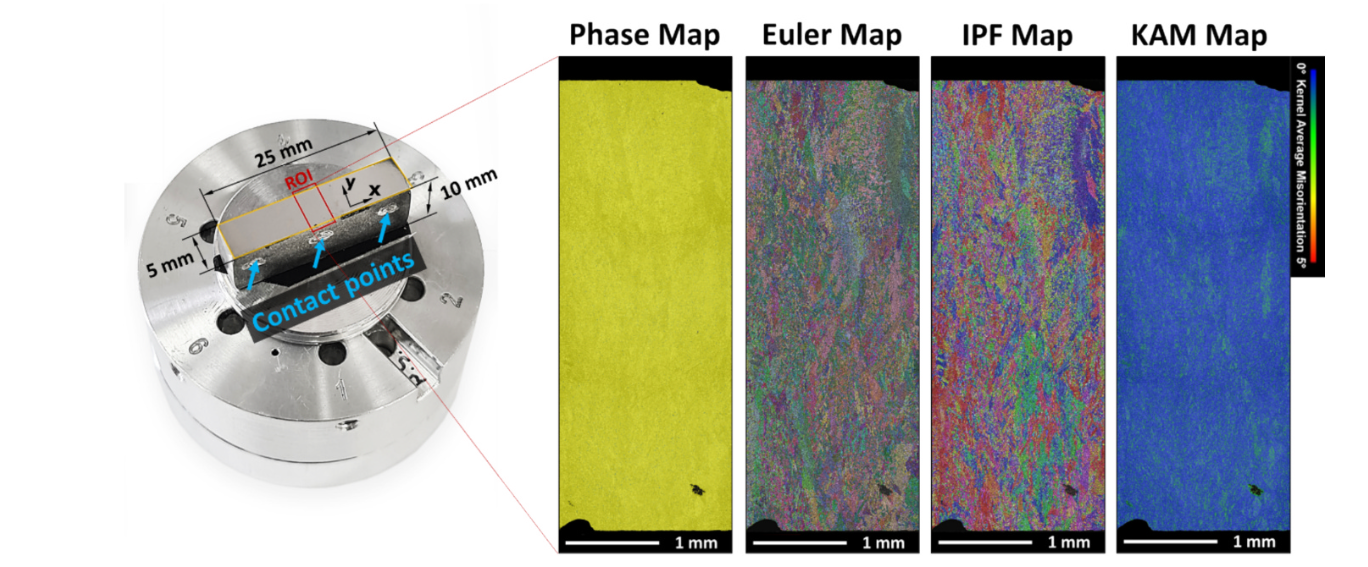
Image 1. General view of the specimen, showing contact areas with the loading frame and the region of interest (ROI) selected for EDS and EBSD analysis, along with a large-area phase map, Euler orientation map, inverse pole figure (IPF) map, and kernel average misorientation (KAM) map. Source: study by the authors.


In the new study, a team led by Professor Alexander Korsunsky, Head of the Laboratory of Hierarchically Structured Materials (HSM) at the Skoltech Engineering Center, author of the original FIB-DIC technique, applied micro-ring-core milling with digital image correlation using two different kinds of ion beam. Evgeny Statnik, a senior research scientist at the HSM lab and the lead author of the study, explains: “Using a xenon plasma source increases the probing volume from 5–20 µm (Ga⁺) to 50–80 µm (Xe⁺), providing access to Type I and Type II stresses according to the Davidenkov classification — that is, values averaged over many grains, which are critically important for predicting the behavior of engineering components.”

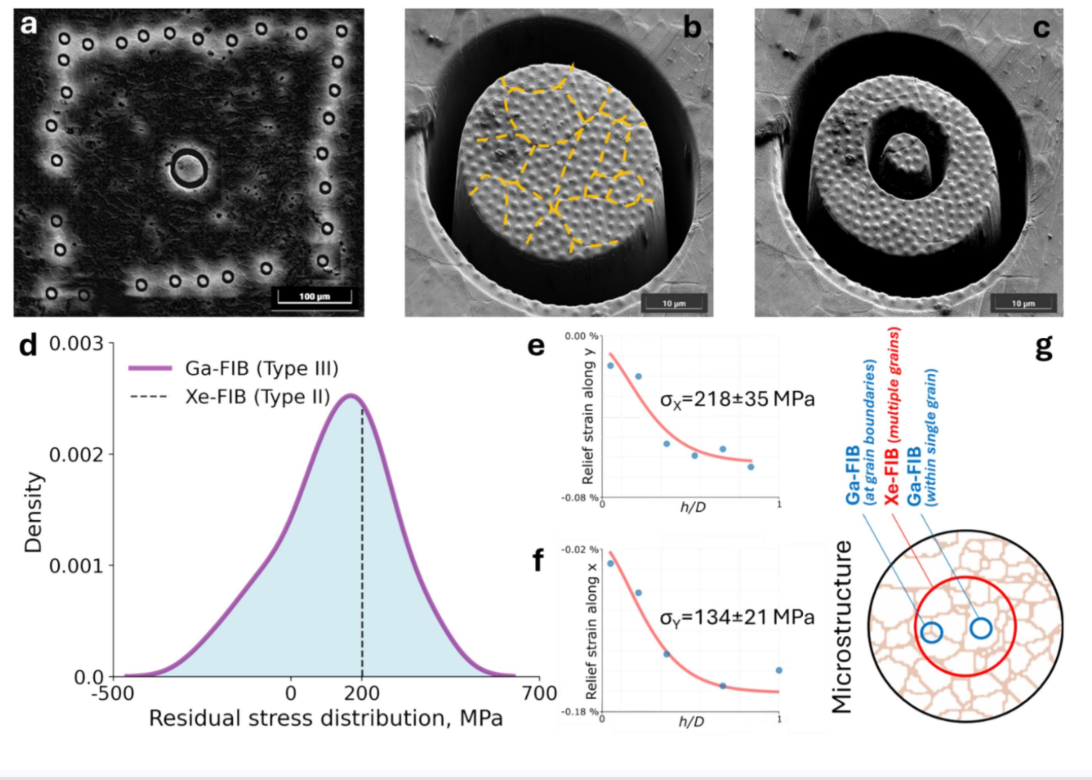
The researchers conducted a series of experiments on Ti-6Al-4V alloy samples subjected to three-point plastic bending. Microstructural analysis using electron backscatter diffraction (EBSD) revealed no pronounced texture and an average α-phase grain size of approximately 9.4 µm, making the material an ideal platform for statistical analysis. The results showed good agreement between the data obtained by Ga⁺ and Xe⁺ FIB-DIC methods, with measured residual stresses ranging from –500 to +500 MPa.

A key methodological contribution of the study was an original “nested experiment”: a micro-ring was milled using a gallium ion beam inside a mesoscale ring previously prepared with a xenon ion beam.

subscription

Image 2. Multiscale residual stress analysis using the FIB-DIC micro-ring-core method. (a) SEM image showing the locations of rings milled with Ga⁺ (microscale, center) and Xe⁺ (mesoscale, surrounding). (b–f) Xe⁺ milled site before and after Ga⁺ FIB-DIC measurement (b, c), grain boundaries, strain relief curves (e, f), and kernel density estimate (KDE) plot of stress values (dashed line indicates the Xe⁺ FIB-DIC value). (g) Schematic: black circle – study area (diameter ~100 µm), red circle — Xe⁺ FIB-DIC (diameter ~50 µm), blue circle — Ga⁺ FIB-DIC (diameter ~15 µm). Source: study by the authors.


“This approach provided direct experimental confirmation of the hierarchical nature of residual stresses: the large Xe⁺ probe averages out small-scale fluctuations, while the small Ga⁺ probe reveals local variations linked to grain morphology and dislocation structure. We have shown that we can deliberately choose the probe scale based on specific scientific and engineering tasks,” emphasized Professor Alexander Korsunsky.

Additionally, the researchers established a correlation between residual stress magnitude and local hardness measured by nanoindentation. This opens up possibilities for non‑destructive rapid assessment of stress states using microhardness maps.

The developed method provides a foundation for integrating destructive (FIB-DIC micro-ring-core) and non‑destructive (X‑ray diffraction, ultrasonic tomography, indentation) approaches into a unified multilevel system for diagnosing internal stress‑strain states in materials, which can help achieve technological leadership in the key areas of aerospace, transportation and energy.


The work was supported by a grant from the Russian Ministry of Education and Science (No. 075-15-2024-552) for large-scale scientific projects in priority areas of scientific and technological development.