The results of the study are published in the journal Physical Review Letters.
"The KPZ class is remarkable in that microscopic details do not matter in it: entirely different systems behave identically in a statistical sense and scale with time and space according to the same numbers — the critical exponents — which are determined solely by the symmetry and the dimensionality of the problem. We have shown that polaritons do not need an etched lattice for this: it is enough to draw the right pump profile with light," explained Distinguished Professor Pavlos Lagoudakis, head of the Hybrid Photonics Laboratory and Provost at Skoltech.
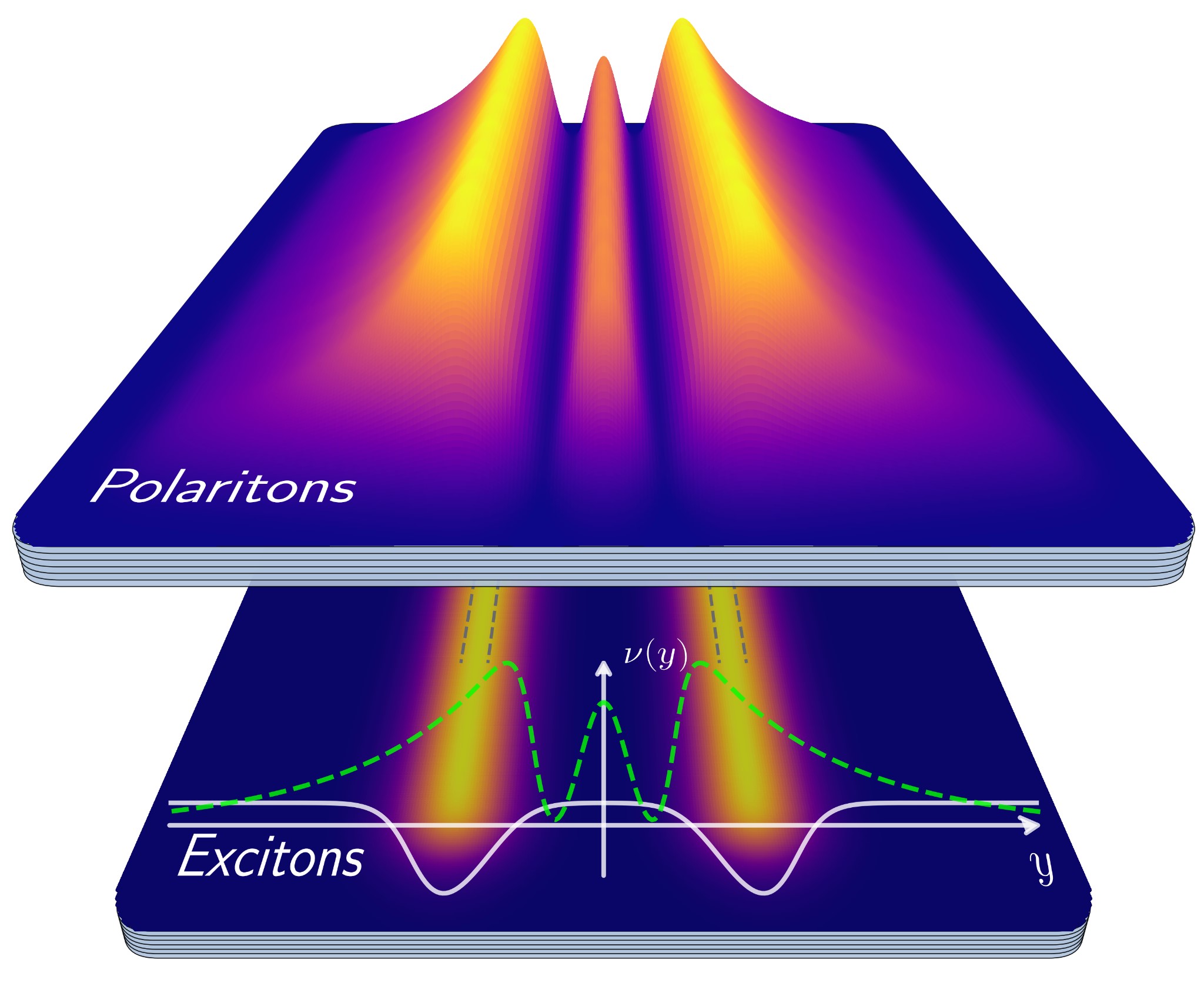
Exciton polaritons are hybrid quasiparticles that arise in an optical microcavity under strong coupling between quanta of light (photons) and electronic excitations in a semiconductor (excitons). They form a coherent macroscopic state, a condensate, characterized by a common phase — and it is precisely this quantity that plays the role of the "height" of a growing surface in the problem at hand. Previously, the KPZ critical exponents and the characteristic asymmetric Tracy–Widom statistics had been obtained in lattices of quantum wells — first in a one-dimensional chain, then in a two-dimensional array. In those experiments, however, it was the engineering of the lattice band structure that stabilized the condensate, and an open question remained: is the same universality possible in a planar, continuous system?
The difficulty of the problem lay in the fact that in a continuous planar microcavity the condensate is fed by a reservoir of incoherent excitons, which also repel it: density fluctuations only grow, the phase diffusion coefficient becomes negative, modulational instabilities develop, and the condensate breaks up into filaments and fills with vortices. A stable, extended "one-dimensional" fluid does not form.
The solution proposed by the authors is to separate the condensate and the reservoir in space. The pump is shaped into two parallel narrow stripes separated by a gap of about ten microns. The exciton reservoirs injected by the pump create a repulsive potential that pushes the polaritons into the gap between them, where a bright interference fringe arises, extending over hundreds of microns. In this fringe there is virtually no reservoir — the condensate is fed only by the influx of polaritons — and the phase diffusion coefficient turns out to be positive. The configuration remains stable out to microseconds of simulated time.
"We numerically solved the stochastic Gross–Pitaevskii equation with parameters taken not 'out of thin air' but measured for a real sample — a planar GaAs microcavity with InGaAs quantum wells, on which our laboratory has already carried out a whole series of experiments. This is essential: we are describing not an abstract model but a configuration that can be assembled on an optical table," said Mikhail Misko, PhD student at Skoltech, co-author of the study.
Following the simulations, the authors verified several independent signatures of KPZ universality at once. The one-point phase fluctuations, rescaled appropriately, fall onto the Tracy–Widom distribution for the Gaussian orthogonal ensemble — exactly the one that theory predicts for flat initial conditions. The two-point phase correlation function obeys Family–Vicsek scaling with critical exponents β ≈ 0.30 and α ≈ 0.46, against theoretical values of 1/3 and 1/2, and after rescaling the data for all times and distances collapse onto a single universal curve. The authors attribute the remaining discrepancy with the exact values primarily to the finite size of the system: the analysis shows that it is the length of the stripe, and not the finite simulation time, that limits convergence to the asymptotic regime.
"The main practical advantage of a fully optical system is the ability to reconfigure it. The shape of the pump is set by a programmable spatial light modulator, and it can be changed in the course of the experiment itself. This opens the way to studying different geometric subclasses of KPZ on one and the same sample: a ring geometry, for example, would make it possible to find out how boundary conditions affect the statistics. And control over the phase diffusion coefficient may give access to the recently predicted Burgers fixed point," added Natalia Starkova, PhD student, at Skoltech, co-author of the study.
The authors regard the proposed scheme as a step toward analog simulators of non-equilibrium universality classes based on polaritons: a system in which one of the two dimensions of a planar microcavity is used to confine the condensate, while the other remains "clean" and free for observing large-scale phenomena of statistical physics.