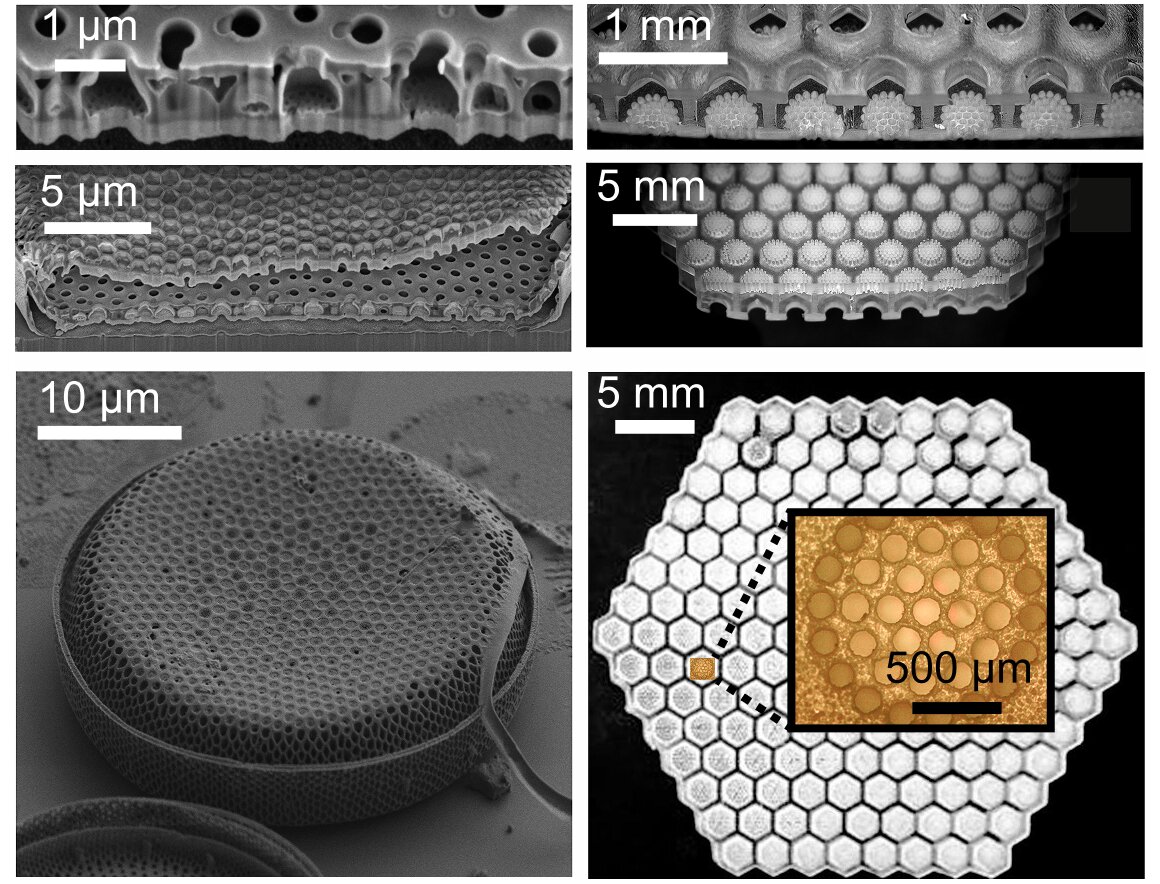
Researchers from Skoltech — a VEB.RF group institution — and their colleagues from Kurchatov Institute, as well as from Prokhorov General Physics Institute and the Institute of Solid State Physics of the Russian Academy of Sciences have recreated a single-celled diatom alga’s patterned shell, scaled up by a factor of 2,000, and used it to confirm a previously predicted optical effect in an experiment with terahertz waves. These hold promise for imaging systems in biology and medicine and for nondestructive material quality tests in industry. The supersized shell’s structure suggests new approaches for building compact components that focus and shape the wavefront in terahertz devices. Backed by a Russian Science Foundation grant, the study was published in Light: Advanced Manufacturing.
The shell of a diatom alga can be thought of as a natural photonic structure. Its intricate three-dimensional architecture functions as a diffraction grating, redistributing the radiation that passes through it. Shaped by millions of years of evolution, the structure of the shell enables its microscopic dweller to focus the scarce sunlight filtering down through the water into a particular radiation pattern inside the shell via what’s known as the Talbot effect.
In the living algae, this effect occurs with visible light. However, when the researchers enlarged the structure 2,000-fold to simplify the experiment, this also shifted the effect into the terahertz range. That’s because the wavelength of the light or other electromagnetic radiation — infrared, terahertz, etc. — that interacts with a grating scales together with its size.
While observing the effect on a magnified scale proved easier, it introduced the new challenge of fabricating a very intricate 3D structure. To reproduce the shell’s multilayered network of pores, the team had to repeatedly capture its complex three-dimensional architecture from many different angles with scanning electron and atomic force microscopes. The collected imagery enabled the shell’s geometry to be reconstructed in great detail and recreated via an additive manufacturing technique called LCD 3D printing, whose parameters had to be meticulously optimized.
Previously, the Talbot effect in the terahertz range had mainly been studied using simpler, flat gratings. For structures with a diatom-shell geometry, the effect had only been predicted — in an earlier study by the same research group — and awaited experimental confirmation.
Terahertz waves hold promise for biomedical visualization and nondestructive material testing devices. Sensitive to the water molecules in biological tissue, medical scans using T-waves are also much safer for the body compared with X-rays and gamma rays. This suggests applications in diagnosing skin cancer, among other conditions. As for material quality tests, they would benefit from the capacity of T-waves to penetrate into dielectric materials, exposing internal defects.
The problem is that the mirrors, lens, diffractive elements, and other optical components adapted for use in terahertz devices are scarce and expensive, and without them no widespread adoption of the technology can reasonably be expected, whether in medicine, science, or industry. This is where the magnified copy of the diatom shell comes in as a model for such components.
“The next step could be moving from a scaled-up demonstration model toward the purposeful design of structures that replicate a diatom shell’s architecture: selecting materials with low optical losses and fine-tuning the geometry for particular tasks. Here, the reliance on a design optimized by nature will considerably simplify calculations compared with creating components from scratch, and 3D printing will make manufacture cheaper than would be possible with lithography,” said study co-author and grant project lead Julijana Cvjetinovic, an assistant professor at Skoltech Photonics.
“This project is a good example of collaboration between universities and major research centers both in the Academy of Sciences and beyond,” noted the study’s principal investigator, Professor Dmitry Gorin, head of the Biophotonics Laboratory at Skoltech Photonics. “It is also worth noting that sometimes — and this case is a prime example — scaling up an object can simplify the experiment without sacrificing the quality of the resulting physical picture of the phenomenon.”