Researchers from Skoltech — a VEB.RF group institution — and their colleagues from the U.S. and China have explained how the gene of antibiotic resistance established itself in the genome of the bacterium Klebsiella pneumoniae. The findings could help control this widespread microbe that can cause pneumonia, meningitis, and other often hospital-acquired infections in patients with weakened immunity. Reported in the Proceedings of the National Academy of Sciences (PNAS), the study was supported by a Russian Science Foundation grant.
Earlier research by Chinese scientists traced back the antibiotic resistance gene of K. pneumoniae to a small free-ranging circular DNA molecule called a plasmid. Primitive self-replicators, plasmids can propagate from the cell of one bacterium to another, even between different species. Because they consume the host’s resources, bacterial immunity attacks plasmids, but they evolve ways of evading or suppressing immunity. In the long run, the invader may even prove beneficial to the bacterium by endowing it with a useful gene.
This happened in the case of drug-resistant K. pneumoniae. While there are clear indications in the DNA of the microbe showing it is equipped with a CRISPR-Cas immune system targeting the plasmid that carries the gene of antibiotic resistance, the bacterial immunity remains idle, paradoxically enabling the bacterium to take full advantage of antibiotic resistance. Any insights into the mechanisms involved in the plasmid-bacterial immunity struggle could come in handy for dealing with the drug-resistant germ. Among the promising lines of research are studies of anti-CRISPR proteins — the biomolecules used by plasmids to suppress bacterial immunity. At Skoltech, this work is carried out in the Biomed Technologies Center’s Laboratory for Metagenome Analysis.
The head of the laboratory, Skoltech Assistant Professor Artem Isaev, who is the principal investigator of the PNAS study, shared the team’s findings: “Our Chinese colleagues had established the link between an anti-CRISPR (Acr) protein and the incidence of infection with Klebsiella pneumoniae. As it turned out, the plasmid carrying the drug resistance gene relied on Acr protein to shut down bacterial immunity. In this study, we showed how this protein works and established it as one of the most widespread anti-CRISPR proteins in nature. We also found that two Acr proteins, AcrIE9 and AcrIE10, always operate in tandem, despite their mechanisms of action being very similar. For now, we cannot say why plasmids exhibit this redundancy in anti-CRISPR function.”
“We also discovered a new anti-CRISPR protein, which seems to have an unusual mechanism of action: It could target the bacterial DNA rather than interact with the CRISPR-Cas immune system proteins,” the researcher added. “At this point, there is no technology we can use to completely eliminate anti-microbial resistance plasmids, but the more we know about their interplay with bacterial immunity, the better our odds of controlling the spread of drug resistance genes.”
This may come as a surprise, but the researchers made their discovery in experiments with a different microbe. The lab was studying Escherichia coli’s CRISPR-Cas immune system, which has been researched for over 20 years. Even so, it remains unclear how this immunity can benefit a bacterium in whose cells it is never active, for all we know. In the study, the team artificially reanimated the dormant CRISPR-Cas system of a laboratory strain of E. coli to see if anti-CRISPR proteins synthesized by plasmids and other mobile genetic elements would shut it down again. Sure enough, proteins inhibiting the immunity turned up among the candidates obtained by the researchers.
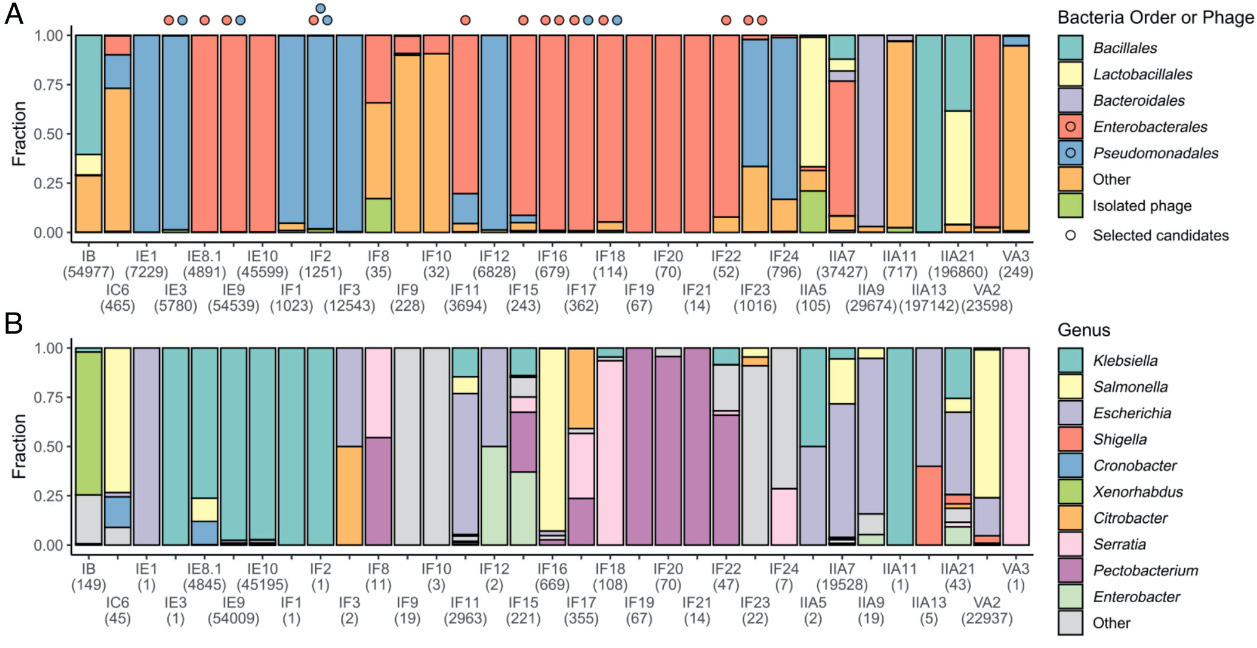
“While these are two distinct bacteria, we realized one and the same plasmid can infiltrate both E. coli and K. pneumoniae, and the same anti-CRISPR proteins enable the plasmid to stick around and establish itself in a microbe’s genome by suppressing its immune response,” Isaev explained. “For the first time, we showed anti-CRISPR activity against the well-studied CRISPR-Cas of E. coli, and this prompted us to perform a systematic analysis of the distribution of anti-CRISPR proteins, revealing how easily they can cross the species boundaries. Anti-CRISPRs may be implicated in the propagation of conjugative plasmids known to modify host cell behavior, the way it happened with K. pneumoniae, which caused an outbreak of drug-resistant infection. Moreover, plasmids encode entire arrays of such anti-CRISPR proteins, which may lead them to establish themselves in diverse cells.”
According to the authors of the study, their findings suggest that medical monitoring should target not just the genes known to confer antibiotic resistance but the anti-immunity genes as well, since they also contribute to the spread of infections. Future research will have to figure out a way to modify this process, possibly by reactivating bacterial immune systems to drive drug resistance genes out of the bacterial population.