Researchers from Skoltech, together with colleagues from the N.D. Zelinsky Institute of Organic Chemistry and Westlake University, have experimentally demonstrated how the operating regime of a polariton laser changes with a gradual increase in cavity thickness. A smooth transition between strong and weak coupling regimes within a single structure has been demonstrated in the visible spectral range using the organic co-polymer MeLPPP. The study opens up opportunities for the development of ultrafast optical transistors and room-temperature coherent light sources. The results of the study, supported by the Russian Science Foundation (project № 25-72-00149), have been published in the Nanophotonics journal.
A polariton is a quasiparticle representing a hybrid of light and matter, formed through the interaction of photons with a semiconductor structure. When a critical density of polaritons in the sample is reached, their wave functions synchronize, and the quasiparticles relax to the lowest-energy state, forming a polariton condensate — a coherent macroscopic state and a source of a coherent light. The process of polariton condensation paves the way for fundamentally new nanoscale lasers that have a low activation threshold and do not require population inversion in the medium.
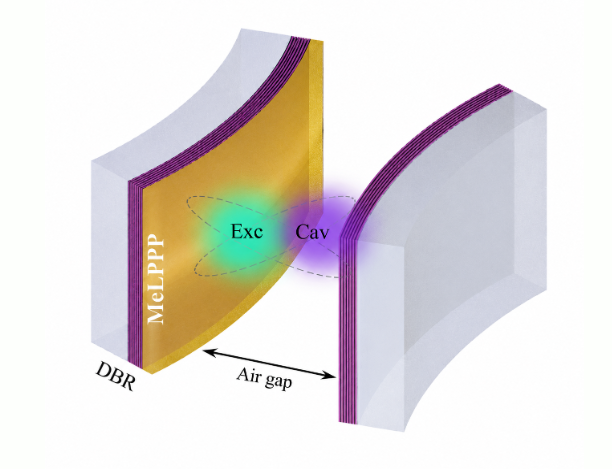
For polaritons to exist, a thin microcavity is required, in which the interaction between a photon and the semiconductor occurs so frequently that light and matter manifest their properties as a single entity — a new quasiparticle with defined energy and momentum. This regime of light-matter interaction is called the strong coupling regime. The study demonstrates a fabrication technique for microcavities with variable thickness, which enables the observation of a smooth transition from the strong coupling regime, accompanied by the formation of a polariton condensate, to the weak coupling regime, where the structure operates as a conventional laser with population inversion.
“We have developed a new approach to forming microcavities,” said Alexander Averchenko, one of the authors of the study, a junior research engineer at the Skoltech Photonics Center. “Instead of the traditional method, we created a special structure: we deposited a thin layer of a special MeLPPP polymer, just 180 nanometers thick, onto a Bragg mirror. We then added a second mirror on top, forming an asymmetric open geometry with an air gap.” The key aspect was the use of local compression, which allows the thickness of the microcavity to be precisely tuned. “This gives us the ability to study the processes inside the laser in detail,” explains the scientist.