Researchers harness nonlinear Compton scattering to create sharper, multicolor gamma-ray beams
January 12, 2026

Researchers from Skoltech, MEPhI, and the Dukhov All-Russian Research Institute of Automation have proposed a new method to create compact gamma-ray sources that are simultaneously brighter, sharper, and capable of emitting multiple “colors” of gamma rays at once. This opens up possibilities for more accurate medical diagnostics, improved material inspection, and even the production of isotopes for medicine directly in the laboratory. The work has been published as a Letter in the journal Physical Review A.

subscription

Gamma rays produced using lasers and electron beams represent a promising technology, but until now they have had a significant drawback: the emission spectrum was too “blurred.” This reduced brightness and precision, limiting their applications in areas where clarity is crucial — such as scanning dense materials or medical imaging.

The team shows that by “stacking” many short laser pulses into a precisely shaped train, they can strongly suppress the spectral broadening that has so far limited nonlinear Compton (Thomson) sources, and even create simultaneous multicolor gamma-ray beams from a single interaction.

Why gamma rays from lasers matter

When a high-energy electron beam collides head-on with an intense laser pulse, the electrons scatter the light and emit X-rays or gamma rays — a process known as inverse Compton scattering. Such laser-driven sources can be compact, tunable, and much more spectrally “clean” than conventional bremsstrahlung sources, making them attractive for:

  • nuclear photonics and non-destructive inspection of dense objects,

  • advanced medical imaging and isotope production,

  • nanostructure and materials studies,

  •  diagnostics of high-density matter.

At very high laser intensities (so-called nonlinear Compton regime), electrons feel strong light pressure and emit radiation at higher harmonics of the laser frequency. In principle this should allow bright, narrow-band gamma-ray lines, but in practice the changing laser intensity across a realistic pulse envelope causes ponderomotive broadening of the spectrum — smearing out the lines and reducing brightness.

Flat-top pulses from “laser Lego”

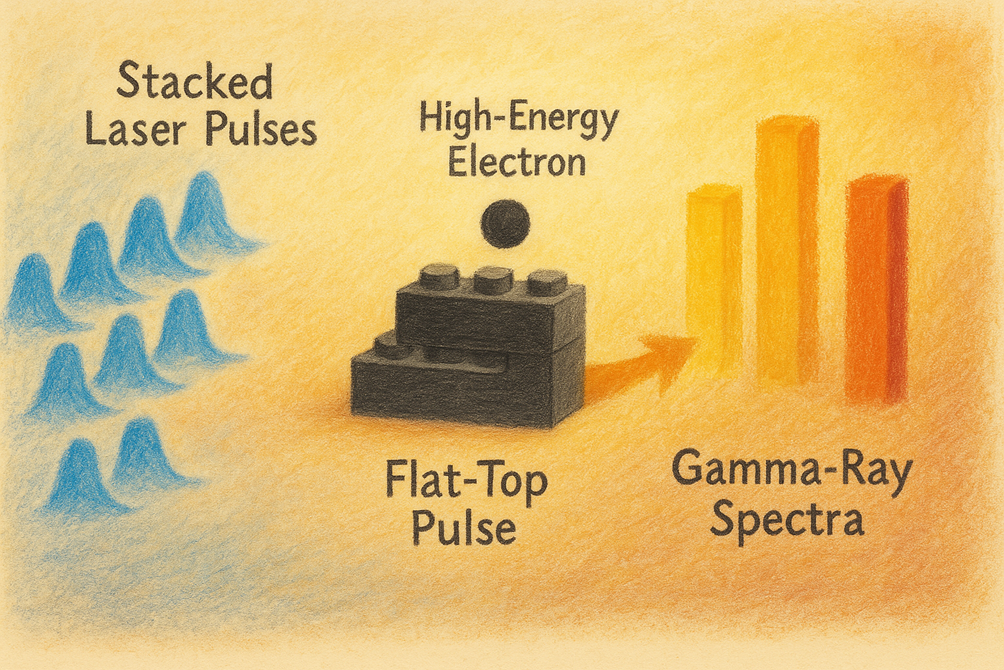
The new work tackles this bottleneck by engineering the temporal shape of the laser field. Instead of a single smooth Gaussian pulse, the authors propose to coherently add (“stack”) many identical short pulses with controlled delays, producing an overall envelope that is much closer to an ideal flat-top (rectangular) pulse. 

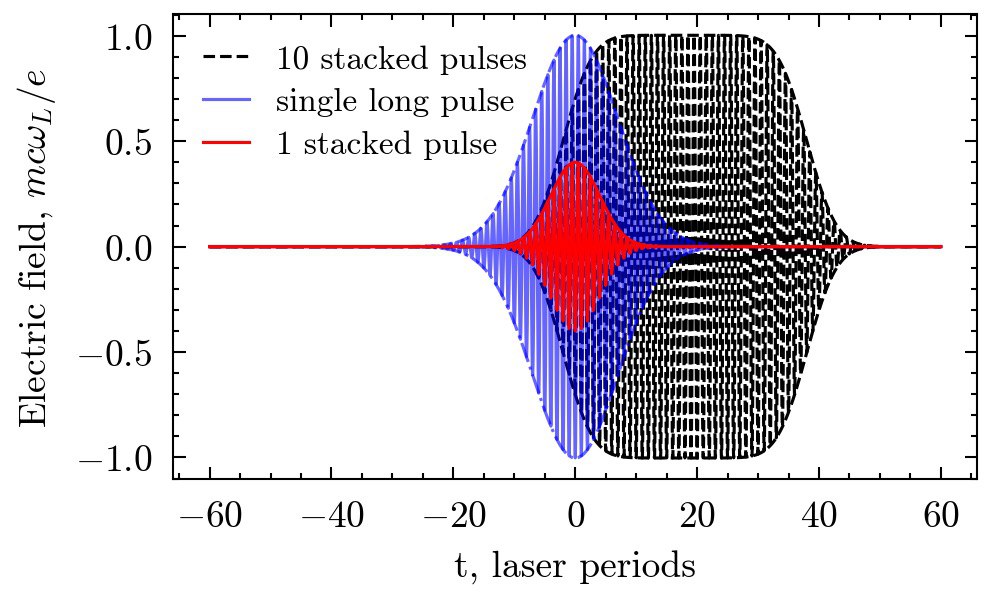
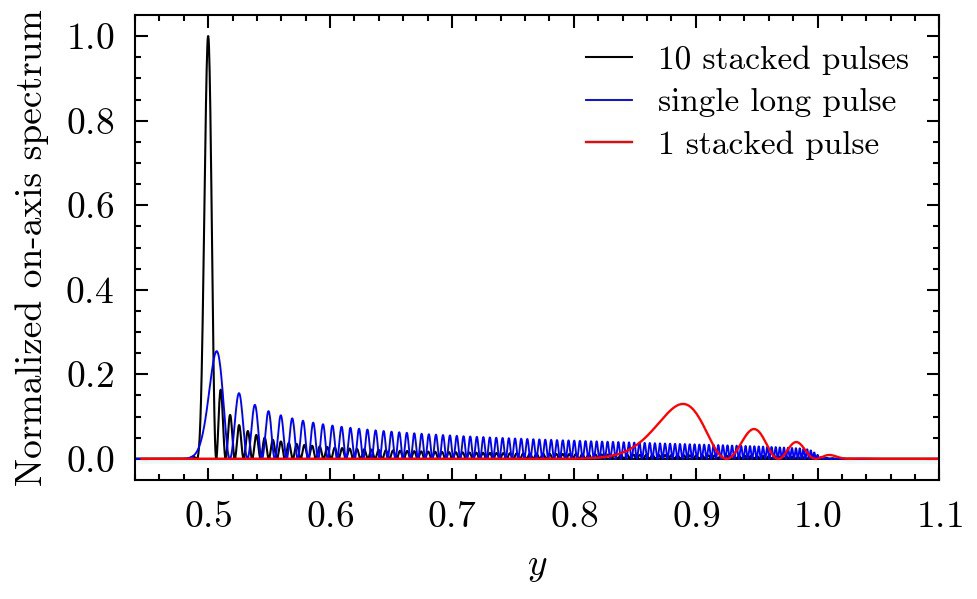
As illustrated in Figure 1 of the paper (see Image 2 below), coherently stacking ten moderately strong Gaussian pulses produces a nearly flat-topped electric field (black curve) compared with a single long pulse of the same total energy (blue curve). For the same peak field strength, the stacked pulse produces about three times more photons within ± 1% of the spectral peak than the single long Gaussian pulse — a direct measure of increased spectral brightness.

subscription
subscription
Image 2. Comparison of laser pulse shaping and its impact on radiation output. Above: The electric field over time is shown for a sequence of 10 short Gaussian pulses combined (superimposed), compared to a single short pulse and a single Gaussian pulse with the same amplitude and total energy as the combined sequence. Below: The corresponding normalized inverse Compton backscattering spectra, illustrating how the pulse structure reshapes the emitted energy distribution. Source: Pulse-stacking technique for nonlinear Compton scattering: Compensation of nonlinear broadening and generation of multicolor gamma sources.

“The idea is conceptually simple: instead of one ‘bell-shaped’ flash of light, we build a flat light ‘plateau’ out of many smaller flashes,” explains Associate Professor Sergey Rykovanov from the Skoltech AI Center. “Electrons then see almost constant intensity while they radiate, which prevents the usual nonlinear broadening of the gamma-ray line.”

Turning one beam into a multicolor gamma source

Beyond narrowing the spectrum, pulse stacking also enables multicolor emission. In another configuration, the researchers divide the pulse train into three groups with different amplitudes, creating a “staircase-shaped” envelope — essentially three flat steps of intensity in time.

When an electron beam interacts with such a staircase pulse, the resulting gamma-ray spectrum naturally splits into three well-separated peaks, each corresponding to one intensity level. In other words, a single laser–electron collision can generate several precisely defined gamma-ray colors at once. Crucially, these multiple colors are a direct fingerprint of the nonlinear Compton regime: each intensity step imprints its own spectral line, something that simply does not occur in the linear (single-photon) scattering limit.

Such simultaneous multicolor beams are promising for spectroscopic “fingerprinting” of materials and for probing complex samples where a single photon energy is not enough.

“With staircase pulses we effectively program the spectrum,” says first author Antonina Timoshenko, a PhD student at Skoltech. “By choosing the height and duration of each step, we can design which gamma-ray colors appear and how intense they are.”

Towards AI-designed laser pulses and mega-science facilities

The authors emphasize that their framework can serve as a digital test stand for exploring pulse designs and control strategies — including AI and machine-learning approaches — before committing to costly hardware.

The work is directly relevant to the planned Intense Compton Radiation (ICR) line of the National Center of Physics and Mathematics (NCPM) in Russia, which aims to build a next-generation narrow-band gamma-ray source. Simulations were performed on Skoltech’s “Zhores” supercomputer and supported by a national AI research center grant.

“Pulse stacking bridges cutting-edge laser technology with the needs of nonlinear Compton sources,” Rykovanov adds. “Our results show that with realistic control of timing, phase and amplitude, we can move towards compact gamma-ray sources with record spectral brightness.”