Solution-processed semiconductors, including organic materials, quantum dots, and metal halide perovskites, present a low-cost alternative to complex epitaxially grown crystals. However, creating electrically driven laser diodes from these materials has remained extraordinarily difficult. Under high current densities, traditional light-emitting diode architectures suffer from severe heat accumulation, which causes material degradation.
To overcome these obstacles, the Skoltech-led research team leveraged the unique physics of exciton-polaritons — the hybrid quasiparticles born from the strong coupling between light (photons) and bound electron-hole pairs (excitons) inside an optical microcavity. Thanks to their bosonic nature, polaritons can collapse into a single macroscopic quantum state — a Bose-Einstein condensate — and emit coherent laser light at significantly lower energy and charge densities than conventional semiconductor lasers.
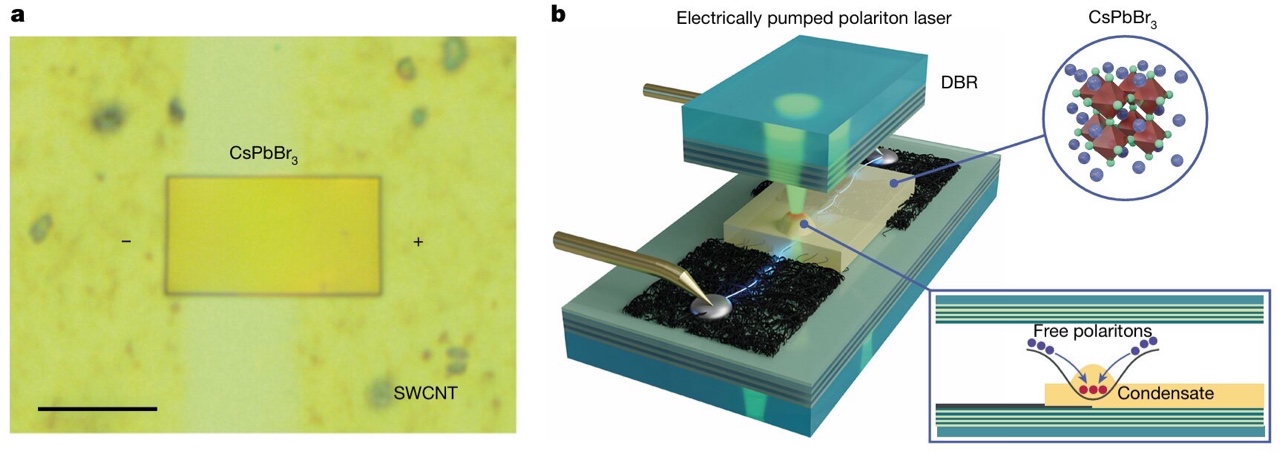
The researchers integrated a solution-grown perovskite microplate with thin-film single-walled carbon nanotube electrodes inside a high-finesse optical microcavity. By implementing a specialized two-stage cryocooling protocol, the team controlled the spatial redistribution of mobile ions to form a stable, frozen p-i-n junction diode.
This frozen p-i-n diode facilitated efficient charge-carrier injection without destroying the perovskite crystal lattice. Under continuous direct electrical current, the device exhibited clear polariton lasing at a low threshold current of 60 microamperes.
“Achieving lasing under direct electrical pumping in solution-processed materials has been one of the key goals in semiconductor optoelectronics for 60 years,” says Assistant Professor Anatoly Pushkarev from Skoltech Photonics, the lead author of the study. “By combining chemically inert carbon nanotube electrodes and mobile halide vacancies of the perovskite lattice, we established a viable route to preventing unwanted reactions at the perovskite-electrode interface and overcoming the thermal bottleneck. Carrier injection in our device yields a highly localized electroluminescence center at the physical defect that we create near the end of a carbon nanotube bundle.”
“This physical defect induces an attractive potential for free exciton-polaritons and yields trapped ones,” adds Senior Research Scientist Stepan Baryshev from Skoltech Photonics, a contributing author of the article. “We clearly observed the three hallmarks of trapped exciton-polariton condensation, namely, the nonlinear increase in emission intensity, the narrowing of the spectral linewidth, and a blueshift of lasing emission above the threshold current.”