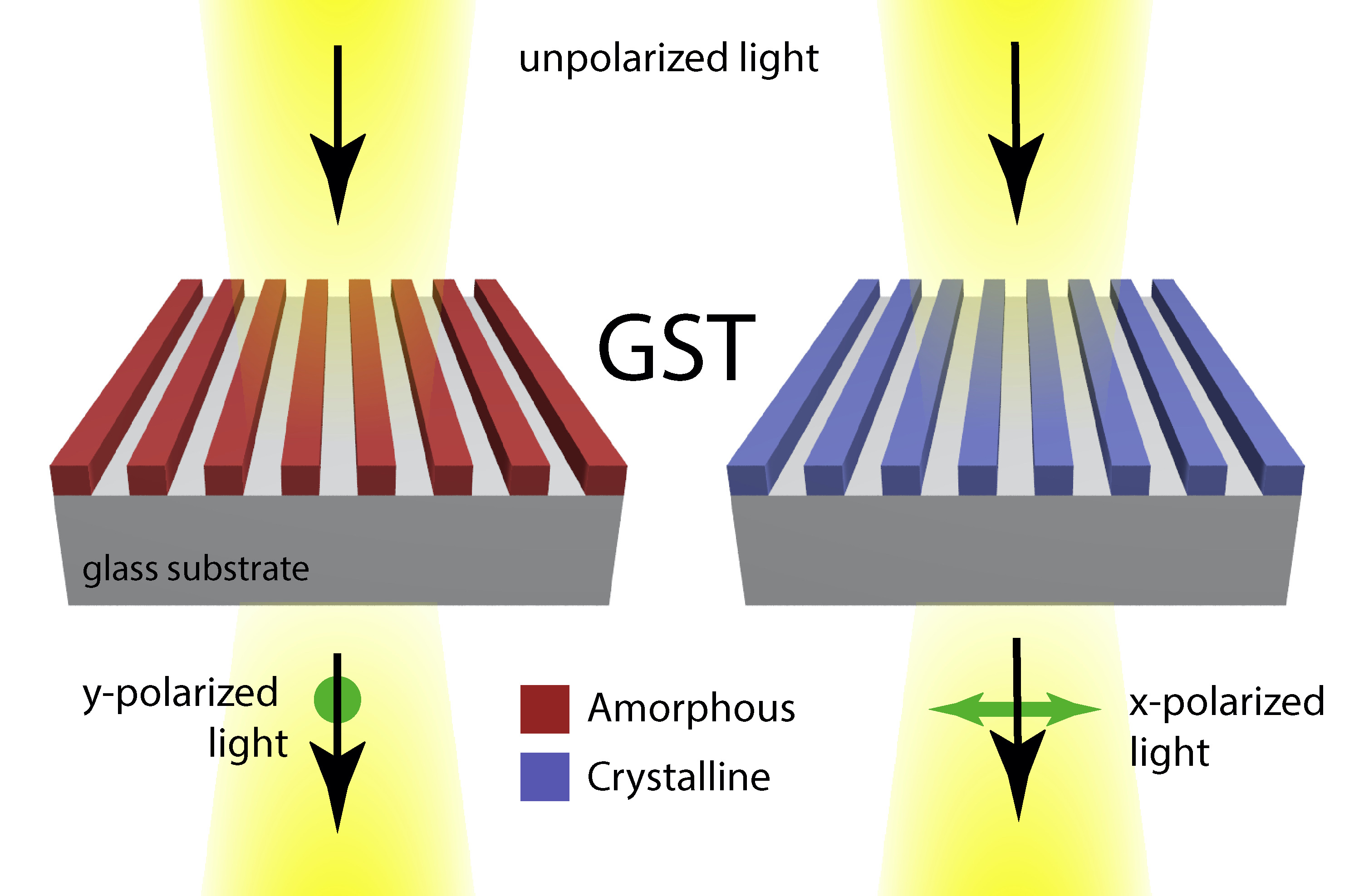
Researchers from Skoltech — a VEB.RF group institution — and their colleagues from National Research University of Electronic Technology and elsewhere have found a way to speed up components that control light polarization in optical communication and computations. Polarization is a property of light that can carry additional information along with the primary signal, enabling higher data throughput. State-of-the-art components that control polarization in optical circuits have to be physically rotated many times a second, wasting precious time. Instead, this can be achieved by varying the temperature of the material the light passes through. This is the finding of a recent Russian Science Foundation-backed study published in Light: Advanced Manufacturing.
“Control of polarization is a very appealing way to pack more data in virtually the same light signal. We have shown a viable alternative: Our modulator, smaller than one-hundredth of a square centimeter, controls the polarization of the light that passes through it by changing the state of the material called GST between an ordered crystal and a disordered amorphous state,” commented the study’s principal investigator, Associate Professor Sergey Dyakov, who heads a research group at Skoltech Engineering Physics.
A compound of germanium, antimony, and tellurium, GST is already used in rewritable Blu-ray and DVD discs, where a laser puts the material in each memory cell in the crystalline or the amorphous state, thus recording information. Used in the new modulator, GST forms a grating that polarizes the light passing through in one of two ways depending on which state the material is in. That state, in turn, is switched by heating.
“In this proof-of-concept work, we deliberately used two slow but clean switching methods — furnace annealing and laser scanning — because our goal here was to measure the maximum achievable optical contrast rather than switching speed,” said study co-author Ilia Fradkin, a research scientist at Skoltech Engineering. “The natural next step is to integrate the metasurface with a thin-film transparent microheater of indium tin oxide or other material underneath the GST layer. This is a well-established approach that has already been shown to switch GST devices on a sub-microsecond timescale, which is fast enough for many applications. And there is a clear path to going even further: Tailoring the composition of the phase-change material and engineering the heat delivery and removal around it can accelerate phase transition and broaden the range of practical applications.”
This is the first time GST has been used in a light polarization modulator. A leading phase-change material in earlier prototypes was vanadium dioxide. The two materials are comparable in terms of extinction ratio — a key performance indicator for polarizers, which measures the extent to which the material transmits light of one polarization, while simultaneously extinguishing light of the opposite polarization. However, vanadium dioxide has one important deficiency: It can retain its amorphous structure indefinitely below 65 degrees Celsius, but it is only above that temperature that it exhibits a crystalline state. This means a long-term switch to one of the two states will require prolonged heating, which wastes energy and is not really viable in an actual device. By contrast, GST is switched into one state by intense, rapid heating and into the other via somewhat slower heating, after which the material retains either of the two structures indefinitely.
Study co-author Leading Research Scientist Denis Zhigunov of Skoltech Engineering Physics added: “Unlike this problem with heating, GST shares another important advantage with one implementation of vanadium dioxide. Namely, it functions as a polarizer in both the amorphous and the crystalline state, yielding distinct polarizations of light. So our prototype effectively provides two polarizers in one device. Other materials polarize light in one of their two states and cease to be a polarizer altogether in another.”
The researchers hope that with further refinements, their modulator can eventually outperform current solutions relying on mechanical rotation and make its way into optical circuits, perhaps as a component of a transceiver converting electrical signals into optical ones with polarization carrying additional information. Such transceivers will be indispensable in high-speed optical communication and computations.