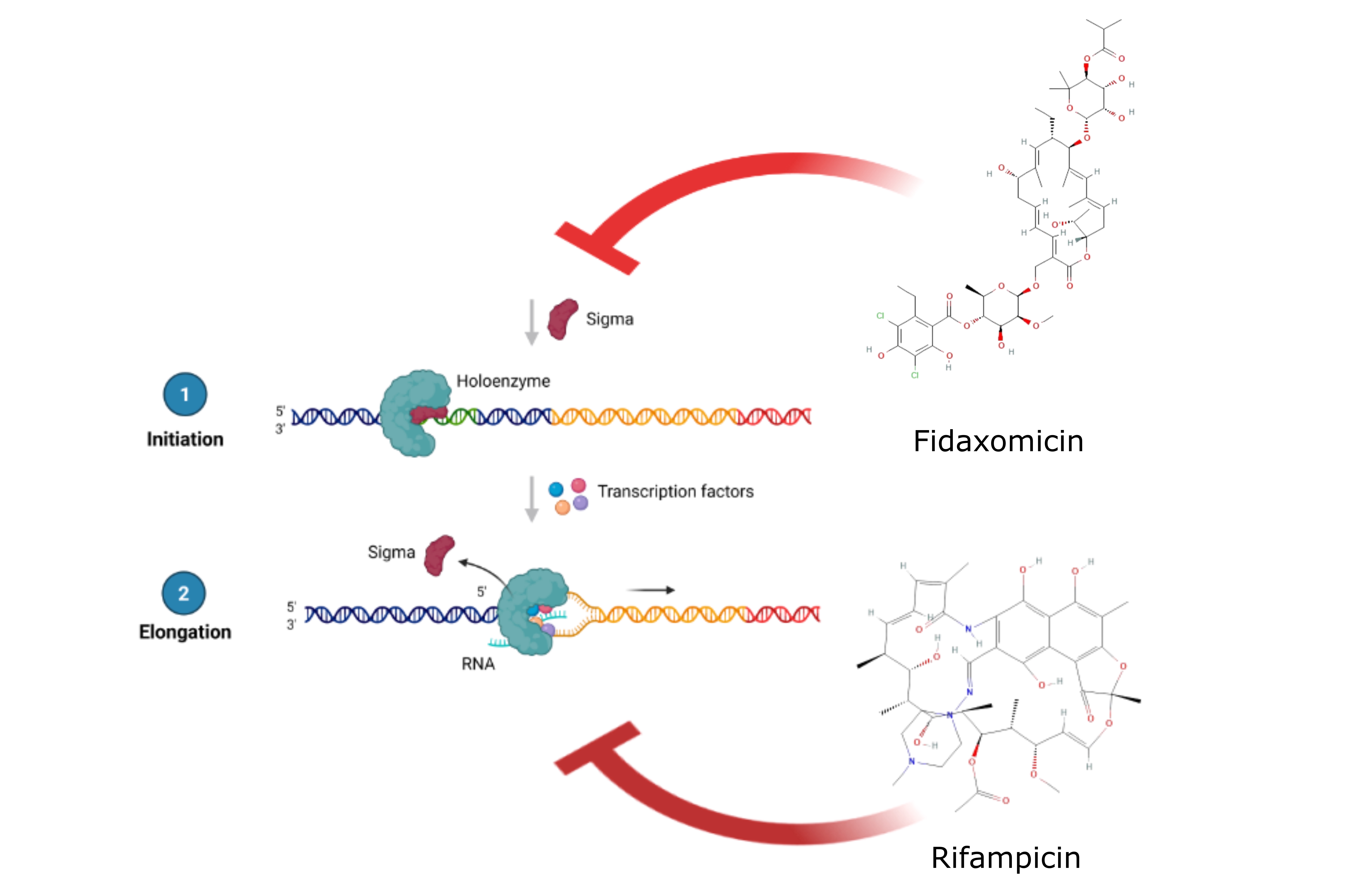
Image. The new antibiotic screening system proposed by the authors of the study proved to be sensitive to both fidaxomicin and rifampicin. These already existing drugs inhibit bacterial RNA synthesis at distinct stages of that process. Credit: Anton Izzy et al./International Journal of Molecular Sciences
Researchers from Skoltech (a VEB.RF group institution) and other science centers in Russia have developed a reporter system — a tool for screening potential new antibiotics — that enables the selection of drug compounds disrupting RNA synthesis in gram-negative bacteria. Among others, these include multidrug-resistant Pseudomonas aeruginosa — a dangerous pathogen responsible for hospital-acquired infections that has already adapted to existing antibiotics. Targeting RNA synthesis is considered a promising mechanism of action for new drugs, since few such agents are known and used and therefore bacteria have not yet had a chance to adapt to them. The study was published in the International Journal of Molecular Sciences and was supported by a Russian Science Foundation grant.
Uncontrolled antibiotic use drives the development of drug resistance in bacteria. As a result, even previously harmless microbes become dangerous. Pseudomonas aeruginosa, for instance, is common in water and soil and readily colonizes the surfaces of medical equipment. Over the past 50 years, it has successively acquired resistance to several classes of antibiotics, making it a formidable cause of hospital-acquired infections. Found on the skin of healthy individuals, Staphylococcus aureus can nevertheless cause pneumonia and other conditions when the immune system is weakened. This bacterium, too, has adapted to several antibiotics that used to kill it.
“One of the main ways to combat antibiotic resistance is to search for new active substances. An important step in studying new compounds is determining their molecular mechanism of action, which can subsequently help overcome bacterial resistance,” explained the study’s principal investigator, Assistant Professor Dmitrii Lukianov from the Center for Biomedical Technologies at Skoltech. “The reason why it is so important to know the mechanism of action of each active compound is that we can eventually study how that compound works in detail and chemically modify it. You see, if a bacterium has evolved resistance to one compound, this does not automatically spell doom for all similar ones. Sometimes we can tweak the molecule in a way that makes it potent again.”
Skoltech researchers have presented an improved tool for targeted screening of potential antibiotic agents against gram-negative bacteria, such as Pseudomonas aeruginosa. The new system is sensitive to compounds that disrupt RNA biosynthesis — a process essential to the life of bacterial cells. The search for drugs that function in that particular way is considered promising because pathogens have not yet had much exposure to them. With relatively few such agents on the market — primarily, rifampicin and fidaxomicin — the germs have not had much opportunity to adapt.
The study’s lead author, biologist Anton Izzi, described what this search amounts to in practice: “Our colleagues obtain an array of candidate compounds, among which a promising antibiotic might be found, and send them to us for screening. We then test them on bacteria in the lab. Well, suppose a compound does kill the bacteria. That actually happens a lot, but it’s not enough. We want to know why. A compound might turn out to be toxic not just to bacteria but to human cells, too. Or it may have a mechanism of action that is common; so resistance to it will be relatively widespread as well. This is where our reporter system comes into play: It exposes the mechanism of action. If an antibiotic targets ribosomes — as tetracycline does — the system will show that. If it disrupts DNA synthesis — as novobiocin does — we will know. Now that the toolkit has been expanded, the new system can ‘see’ compounds that inhibit RNA synthesis, as rifampicin does.”
The new reporter system is based on a specially engineered laboratory strain of Escherichia coli. The bacterium carries a special gene that is expressed more strongly when transcription — that is, RNA synthesis — is disrupted compared with situations when other forms of stress are experienced. This means that the gene becomes more active: More messenger RNA is produced from it, which in turn serves as a template for building a certain protein. The messenger RNA is detected via the real-time polymerase chain reaction method, and the system developed by the researchers then signals that the compound in question inhibits RNA synthesis.
Using the reporter system speeds up the screening process and therefore improves the chances of finding new drug molecules active against antibiotic-resistant strains of dangerous pathogens. Without such a system, the compound selection stage would require researchers to examine the molecular structure of each candidate, infer potential targets from it, and then verify those targets — a considerable number of additional tests.