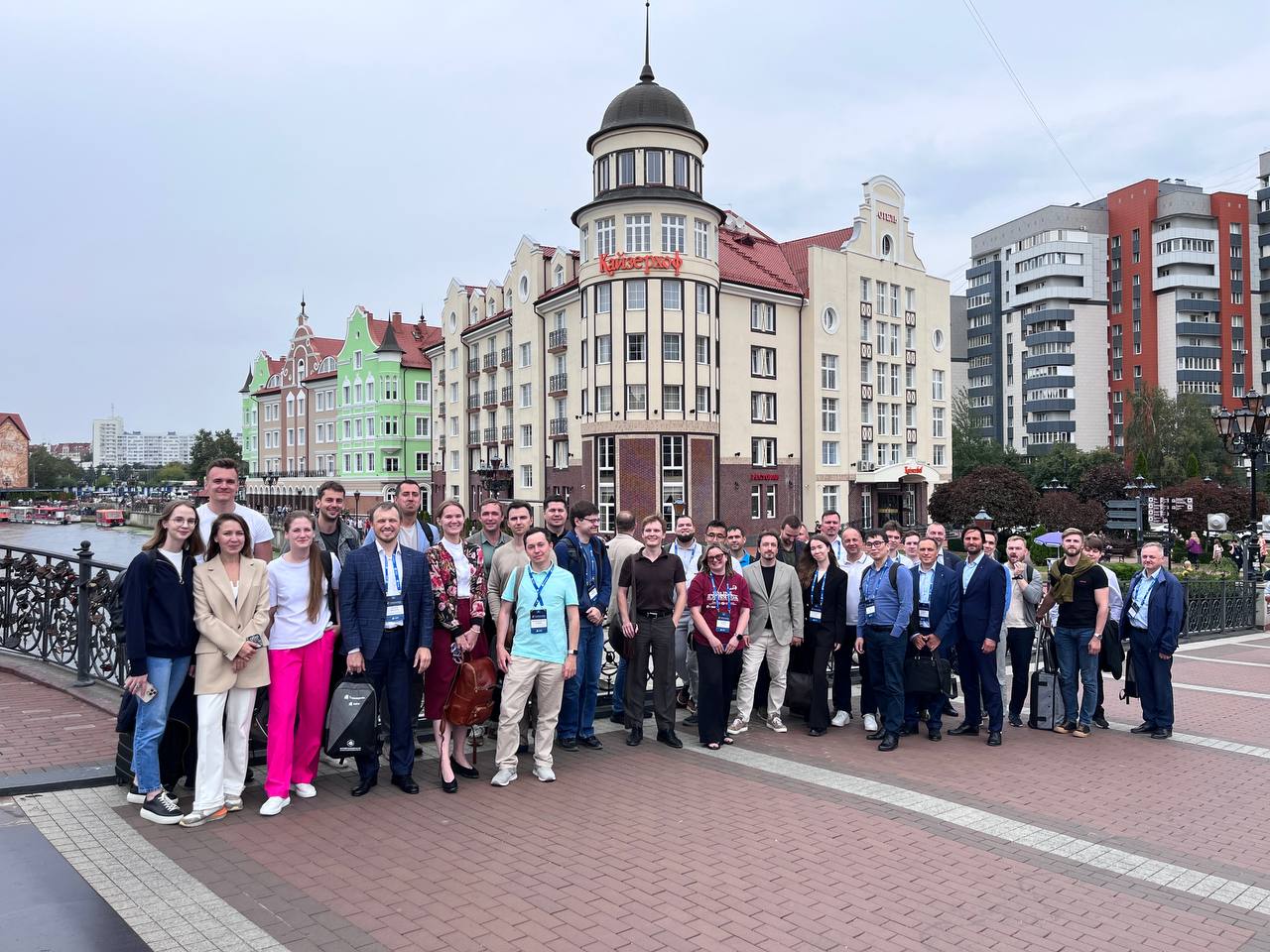
Our colleagues from Applied AI Center — Sergey Shumilin, head of the research group, Alexander Ryabov, research engineer, and Damir Akhmetov, junior research engineer — participated in the 5th anniversary international scientific-practical conference held in Kaliningrad.
Sergey Shumilin's study, "Field Model Adaptation to Production History Using a Comprehensive Approach Based on Simultaneous Integration of Heterogeneous Data and Bayesian Optimization in a Compressed Parameter Space," received the "Best Presentation" award. Sergey presented results on the use of Bayesian optimization for black-box functions in field model adaptation. Within the "Universal Pipeline" project, the team successfully adapted the field model automatically and achieved forecast quality surpassing that of manual adaptation. The proposed algorithm requires only a few hours of work compared to manual adaptation, which can take months or even years.
Alexander Ryabov presented two talks:
- "Neural Network Modeling of 3D Property Fields with a Trainable Basis Using an Autoencoder" — about creating three-dimensional cubes of physical properties, such as permeability, using neural networks. This method helps fill the space between wells by utilizing data from 2D maps and vertical profiles. The method is being tested on permeability maps that integrate data from geophysical, hydrodynamic, and seismic studies.
- "A Compositional Algorithm for Constructing Cubes of Statistically Related Geological and Hydrodynamic Properties of Reservoirs Based on Kernel Regression and Cross-Linked Convolutional Neural Networks" (the first author of the project is Mikhail Anisimov, junior research engineer at the Skoltech Applied AI Center) — about a new algorithm that helps build three-dimensional models of subsurface properties, such as porosity and permeability, for more accurate calculations of oil or gas production.
Damir Akhmetov's presentation focused on the application of a physics-informed neural network for predicting the dynamics of reservoir pressure changes around an operating well, considering the filtration equation in a single-phase setting. The model operates several orders of magnitude faster than numerical simulators, allowing its use for various fluid flow modeling tasks. In the future, this model could be extended to handle multiphase flows, enabling more complex subsurface hydromechanical problems to be solved using a neural network approach.