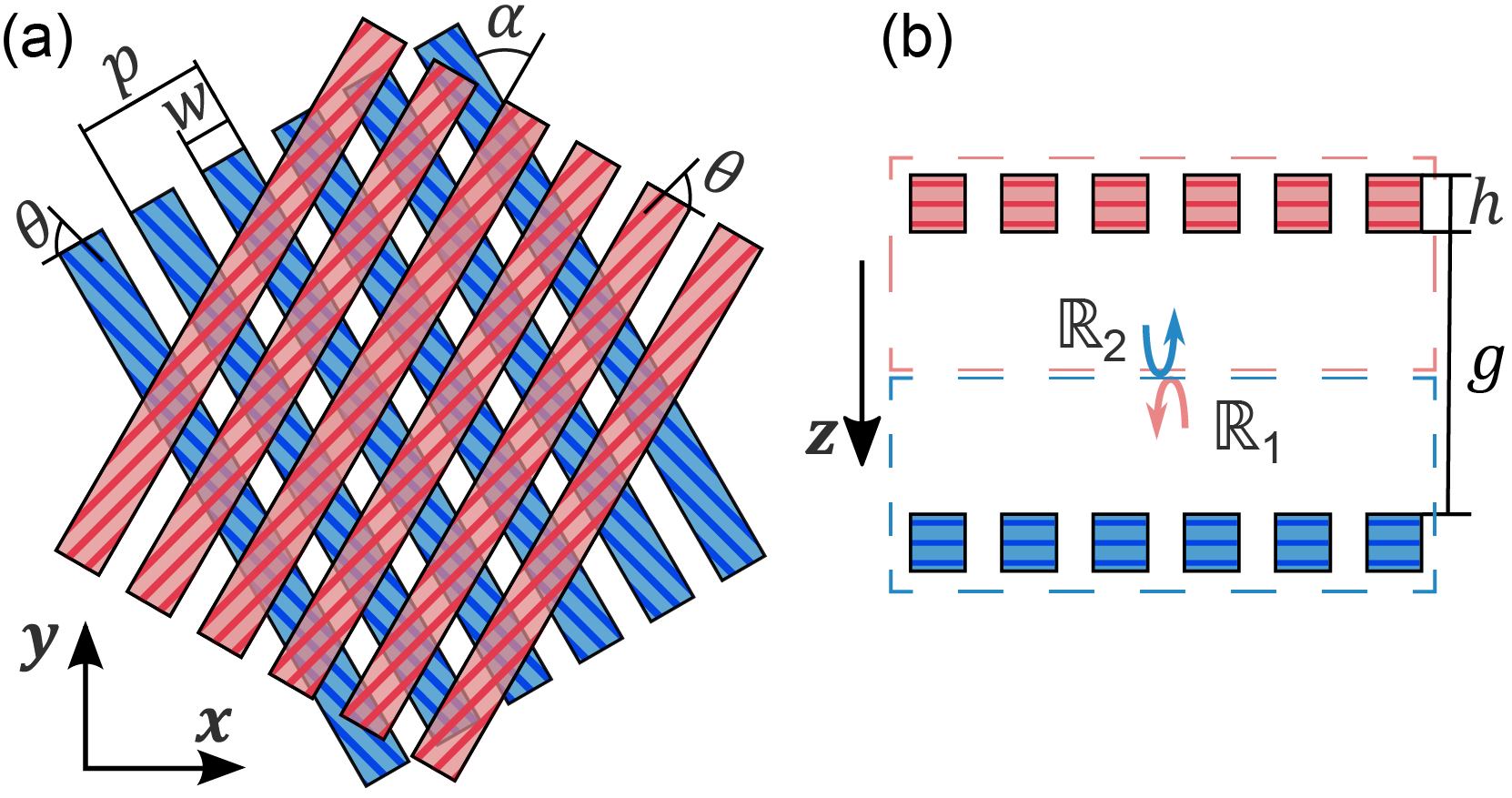
This last point is fundamentally important: the equilibrium angle does not depend on the gap between the gratings. This means that once two chiral gratings are brought sufficiently close together, they “know” which orientation to adopt and do so autonomously under the action of the Casimir torque. This property makes them promising candidates for self-assembly elements in nanophotonics.
Natalia Salakhova, a junior research scientist at the Skoltech Engineering Physics Center and an MIPT graduate, commented: “The key finding is that the equilibrium angle is determined by the intrinsic parameters of the material. This provides a new degree of freedom for designing photonic nanostructures with predetermined behavior.”
Ilya Fradkin, a research scientist at the Skoltech Engineering Physics Center and at the MIPT Laboratory of Nanooptics and Plasmonics, described the significance of the work as follows: “Until now, the Casimir torque has been viewed as a curious physical phenomenon that is difficult to use practically — its magnitude is small, and its angular dependence is too simple. The introduction of chirality fundamentally changes the picture: a nonzero equilibrium angle emerges, dictated by the material’s properties. This makes it possible to design nanostructures that autonomously find the correct orientation without any external control.”
According to co-author Sergey Dyakov, an associate professor and the head of a research group at the Skoltech Engineering Physics Center, the practical application of this discovery lies in the field of reconfigurable nanophotonics. Optical components capable of autonomously assuming a specified angular position without mechanical actuators could be used in ultra-miniature sensors, optical switches, and quantum optical circuits where external mechanical intervention is either impossible or undesirable.
As stated by Nikolay Gippius, the head of the Theoretical Nanophotonics Group and Professor at the Skoltech Engineering Physics Center, the research team’s next step is to search for materials with optimal anisotropy to maximize the Casimir torque.