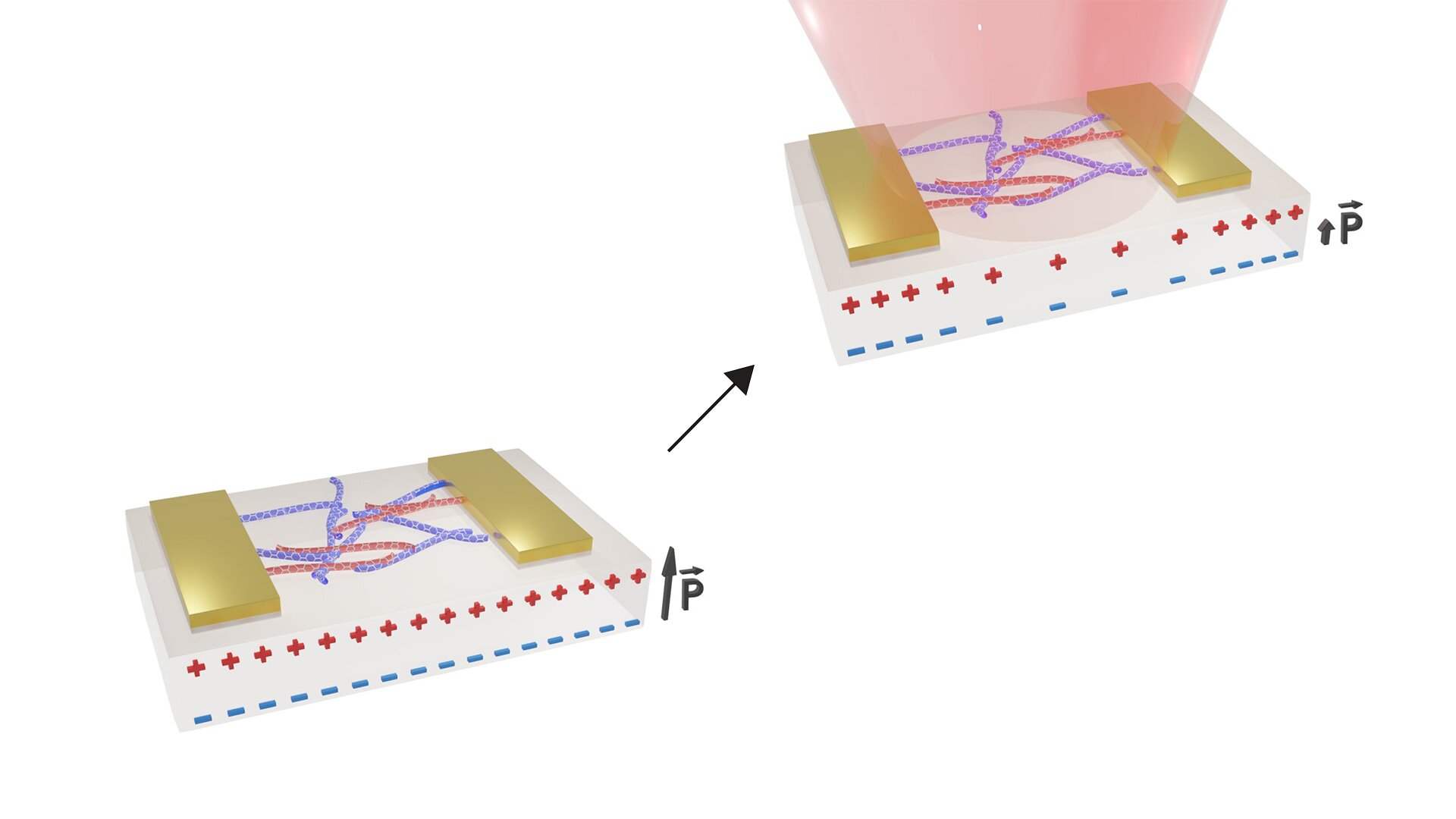
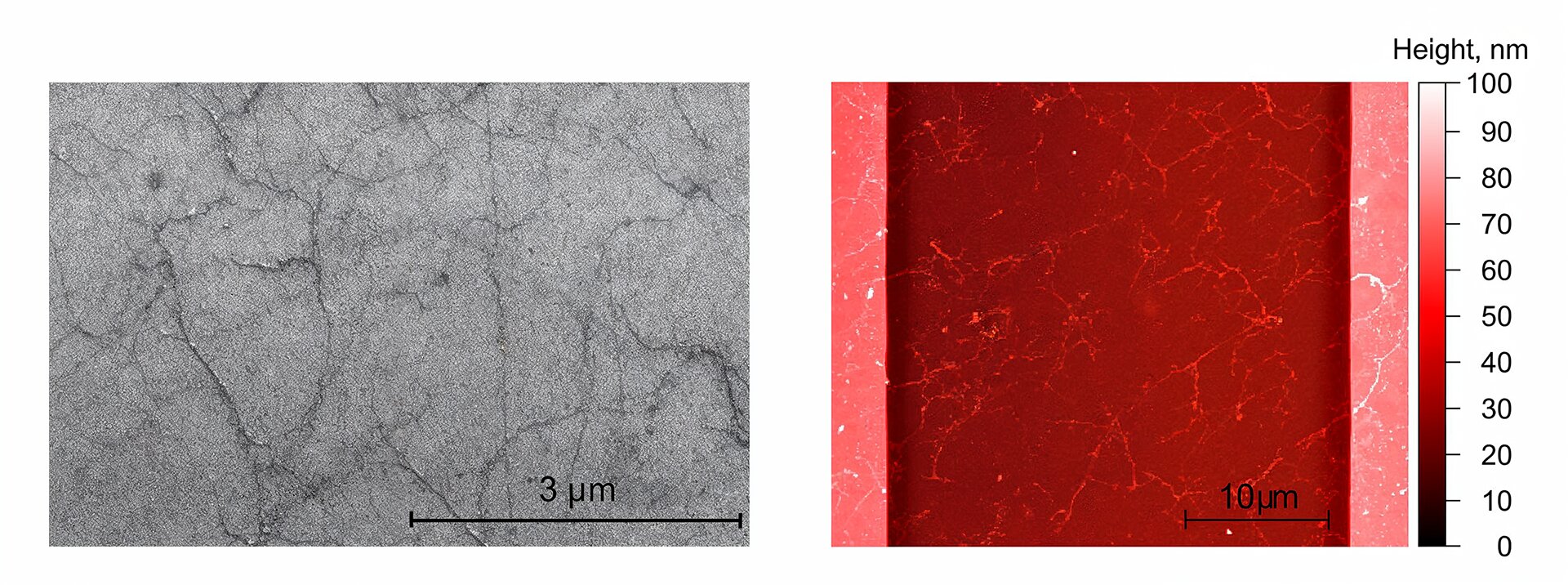
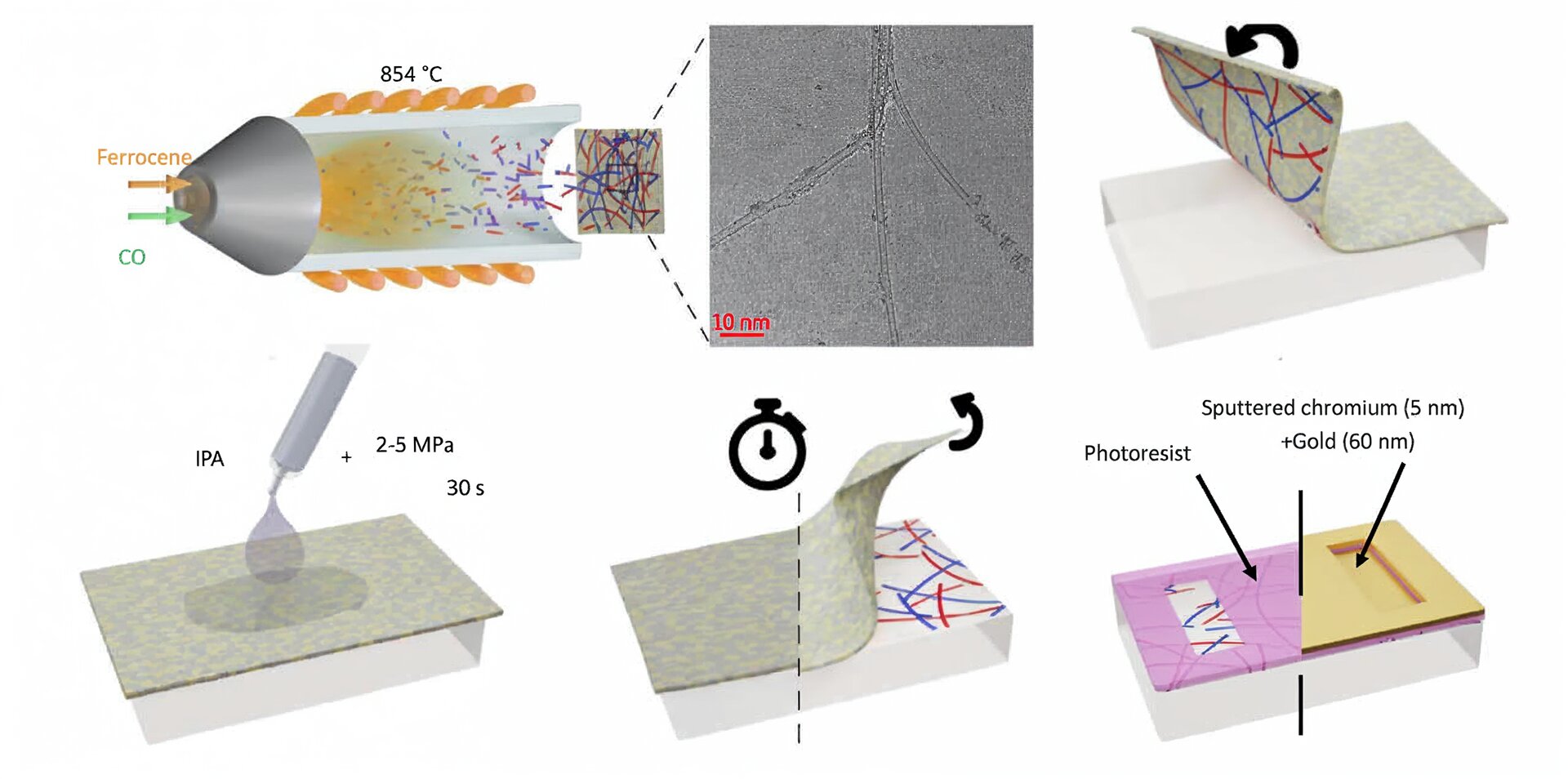
Image. When infrared radiation (red beam) hits the detector, lithium niobate (gray layer) generates an electric field. It changes the conductivity of the above network of single-walled carbon nanotubes, deposited between two gold contacts. This in turn signals that the detector has picked up infrared radiation. Credit: Serebrennikova et al./Opto-Electronic Advances
Researchers from Skoltech — a VEB.RF group institution — have devised a way to detect infrared radiation across a wide range without cooling the detector. This promises cheaper and smaller contactless thermometers and sensors for medicine, industry, fire and chemical hazard monitoring. To detect infrared light, the team measured the change it induced in the electrical conductivity of single-walled carbon nanotubes. The observed change in conductivity was thousands of times more noticeable than in graphene, used in analogous detectors previously. The findings were reported in an Opto-Electronic Advances paper, backed by Russian Science Foundation grant No. 22-13-00436-П.
Mid- and far-infrared sensors pick up the radiation associated with heat. They are used to spot heat insulation gaps and plumbing leaks with thermal imaging cameras and to remotely measure object and body temperature, for example in industrial processes, fire-safety monitoring, and anti-COVID measures at public events. In infrared spectroscopy, such sensors help determine the composition of a gas or solid, enabling fast, contactless material analysis. Among other applications, this is useful in drug manufacture and gas leak detection at industrial sites, as well as for detecting infrared signals in fiber-optic networks.
There are two ways to “catch” infrared radiation: either with photonic or with thermal detectors. The former are expensive semiconductor-based devices. They deliver high sensitivity in distinct parts of the infrared spectrum, but only if cooled. This makes the hardware more complex, expensive, bulky, and power-hungry. Thermal detectors, by contrast, can register a wide range of infrared radiation at room temperature. Ambient heat, however, randomly disturbs the electrons, causing so-called thermal noise in the system, which introduces significant measurement error. That is precisely the problem tackled by the Skoltech team.
A thermal photodetector registers light through changes in the physical properties of the sensing element. Graphene, for example, heats up as it absorbs infrared radiation and changes its resistance accordingly. The resulting shift in the electrical signal contains information about the temperature and the absorbed radiation. But this effect is too weak on its own, so graphene is typically paired with another material, such as lithium niobate, which generates an electric field as its temperature changes and dramatically amplifies the signal in graphene, boosting sensitivity.
“The problem is that many applications require even greater sensitivity to pick up faint radiation,” said the study’s lead author, Svetlana Serebrennikova, a PhD student in Skoltech’s Physics program. “What we did was replace the graphene layer in the detector with single-walled carbon nanotubes. When illuminated with infrared light, the change in their resistance under the electric field generated by lithium niobate is 10,000 to 100,000 times more pronounced than in graphene. As a result, we get both high sensitivity and room-temperature detection across a wide infrared range.”
The key to this strong response has to do with the very nature of nanotubes as a material. Unlike graphene, the semiconducting single-walled carbon nanotubes have a bandgap, which means their conductivity can be controlled with an electric field — much like in a transistor.
“Graphene is an excellent conductor, but that is precisely why it is difficult to ‘switch.’ It lacks a bandgap, so an electric field only has a small effect on its conductivity,” Associate Professor Yuriy Gladush of Skoltech Photonics, a co-author of the study, commented. “As a semiconducting material, nanotubes do have a bandgap, and the weak field generated by lithium niobate upon heating radically alters the nanotube network’s resistance — by four to five orders of magnitude. Essentially, our detector operates as a pyroelectric phototransistor, where heat from absorbed light is converted into a control signal. Moreover, nanotubes are sensitive across an exceptionally wide range from visible light to far-infrared and even terahertz radiation, paving the way for more versatile, broadband receivers.”
The boost in sensitivity came not only from replacing graphene with single-walled carbon nanotubes, but also from the high quality of the nanotubes themselves, as well as their defect-free transfer from the synthesis reactor onto the lithium niobate substrate.